How to Prevent Scope Creep as a Freelancer
You quoted a project at 20 hours, but the final time log says 34. The client added "just one more thing" five separate times, and you said yes to every single one. Now your effective hourly rate on this project is 40% lower than what you planned, and you have no one to bill for those extra hours. If this sounds familiar, you are dealing with scope creep, and learning how to prevent scope creep as a freelancer is the single most important skill for protecting your income.
What Scope Creep Actually Looks Like
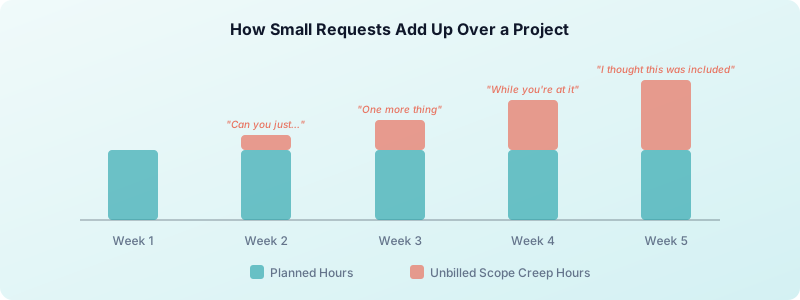
Scope creep is the gradual expansion of a project beyond its original deliverables without a matching increase in budget or timeline. It rarely shows up as one dramatic moment. Instead, it builds through a series of small, reasonable-sounding requests.
Here are the phrases that signal scope creep is starting:
- "Can you just..."
- "While you are at it..."
- "I thought this was included."
- "One more small thing."
- "It should be easy, right?"
Each individual request might take 30 to 60 minutes. But over a six-week project, those additions can total 15 to 20 hours of unbilled work. A project you quoted at $3,000 can quietly drop your effective rate from $100 per hour to $60 per hour, and without tracked data, you might not even realize it happened.
The key thing to understand: scope creep is rarely malicious. Most clients are not trying to get free work. They simply do not know where the boundary is because no one defined it clearly.
Define Your Scope of Work Before Starting
The single best defense against scope creep is a detailed scope of work document. Vague proposals create vague expectations, and vague expectations are where scope creep thrives.
A strong scope of work includes five elements:
1. Specific deliverables. Not "build a website" but "build a 5-page website (Home, About, Services, Portfolio, Contact) with responsive design and a contact form." The more specific you are, the less room there is for misinterpretation.
2. Explicit exclusions. State what is not included. If the website project does not include copywriting, animation, or e-commerce functionality, write that out. Exclusions prevent the most common scope creep scenario: the client assuming something was included because you never said it was not.
3. Revision limits. Specify how many revision rounds are included. Two rounds is standard. When clients know revisions are limited, they consolidate feedback into thorough, organized rounds instead of sending one-off changes for weeks.
4. Timeline and milestones. Break the project into phases with specific delivery dates. Milestones create natural checkpoints where both sides confirm the project is on track before moving forward.
5. A signed agreement. The scope of work means nothing without the client's signature. Send it as part of your contract or as a separate document, and do not start work until you have written approval.
If you are working on improving your freelance invoicing process, building detailed scopes of work is a natural companion step. Clear scope documents lead to clean invoices with no surprises.
Build a Change Request Process
Even with a perfect scope of work, clients will ask for changes. That is normal. The goal is not to prevent every change request but to have a process that handles them without eroding your income.
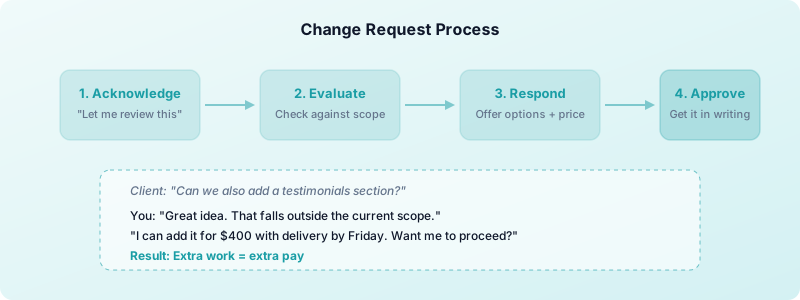
Here is a simple change request workflow:
Step 1: Acknowledge the request. "Thanks for sharing that idea. Let me review whether it falls within the current scope."
Step 2: Evaluate against the scope. Check your signed scope of work. Does the request match an existing deliverable, or is it something new?
Step 3: Respond with options. If it is out of scope, reply with something like: "This is a great addition. It falls outside the current scope, so I can add it for $X with a delivery date of Y, or we can include it in a follow-up phase."
Step 4: Get written approval. If the client approves the additional work, update the scope document and confirm the new budget and timeline in writing before starting.
The key is to build this process before the project starts and explain it to the client during onboarding. When a change request comes in, you are not making a judgment call in the moment. You are following a process both sides agreed to.
Use Time Tracking to Catch Scope Creep Early
Most freelancers can feel when a project is taking longer than expected. The problem is that without tracked data, the actual cost of those extra hours stays invisible. You finish the project feeling drained but cannot point to exactly where the overrun happened.
When you track your billable hours at the task level, scope creep becomes measurable:
- You see overruns in real time. If your tracked hours on a fixed-price project exceed your estimate by 20%, you know to have the scope conversation before it reaches 50%.
- You can quantify the cost. Instead of saying "this project took longer than expected," you can say "the three out-of-scope requests added 12 hours of work at a cost of $1,200."
- You build better estimates. Over time, your time data becomes a personal estimation database. You stop guessing and start pricing based on actual historical data.
- You protect the relationship. When you show a client that their "small" requests added 15 hours to the project, the conversation shifts from feelings to facts. Data removes the awkwardness.
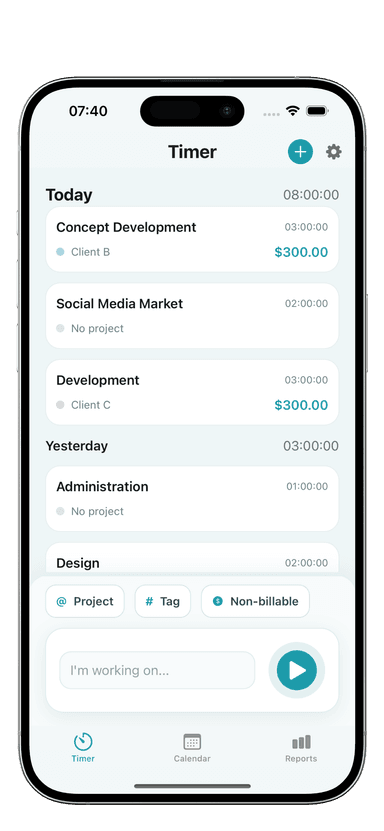
Toggle Time Tracker makes this practical. Tag each time entry with the specific task or phase, and you can see exactly where a project goes off-track. Because it works offline and needs no account setup, you can start a timer the moment a client calls with a "quick question" and capture that time immediately.
Set Boundaries During Client Onboarding
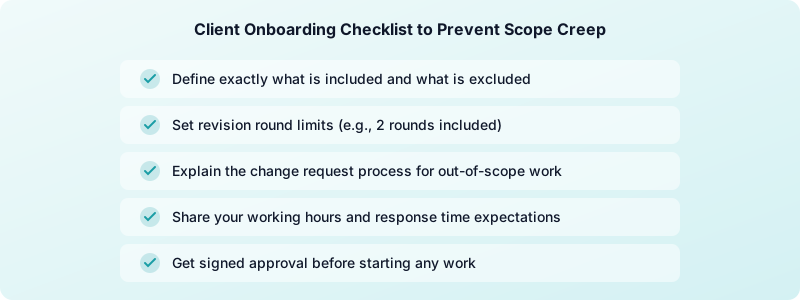
Prevention works better than correction. The easiest time to set expectations around scope is before any work begins, during your client onboarding process.
Cover these points in your kickoff call or onboarding email:
- What is included in the project and what is not
- How many revision rounds are included and what happens after those are used
- How to request changes that fall outside the original scope
- Your working hours and response time expectations
- The approval process for each milestone before moving to the next phase
Clients who understand the rules from day one rarely push boundaries. Learning how to set boundaries with freelance clients is one of the best ways to prevent scope creep before it starts. Spending 15 minutes on onboarding expectations saves hours of uncomfortable negotiations later.
If you are building out your client management systems, this fits naturally alongside your broader strategy for managing multiple freelance clients. Clear onboarding prevents scope creep, reduces miscommunication, and builds trust from the start.
Turn Scope Creep Into Paid Work
Not every out-of-scope request is a problem. Some of them are opportunities. The goal is not to say no to everything but to make sure additional work comes with additional compensation.
Three strategies that work:
Document freebies on your invoice. Even if you do not charge for a small addition, list it on the final invoice with a 100% discount. The client sees the line item, understands it was extra, and is less likely to expect freebies next time. For example: "Additional homepage banner revision — $150 (waived, courtesy)."
Create an add-on menu. For recurring client types, build a list of common additions with set prices. When a client asks for something extra, you can respond instantly: "That is available as an add-on for $200. Want me to include it?" Pre-defined pricing removes the negotiation.
Propose a follow-up phase. For larger additions that do not fit the current timeline, suggest a Phase 2. "Let us finish the current scope first, and I will put together a proposal for these additions as a separate project." This keeps the current project on track while keeping the client's ideas alive.
The freelancers who earn the most are not the ones who refuse extra work. They are the ones who have systems to capture, price, and deliver it without giving anything away for free.
Protect Your Income With Systems
Scope creep costs the average freelancer thousands of dollars per year in unpaid work. But it is entirely preventable with the right systems: detailed scopes of work, a change request process, time tracking at the task level, and clear onboarding conversations.
Start with one change this week. If you do not have a written scope of work template, create one. If you are not tracking your hours by task, start today. Even small improvements compound over time into significantly better project profitability.
Download Toggle Time Tracker and start tracking your hours at the task level so you can spot scope creep before it eats into your bottom line.