How to Set Boundaries with Freelance Clients
A client texts you at 9 PM on a Saturday asking for "a quick update." You open your laptop, spend 45 minutes on the task, and close it without logging the time. By Monday, two more requests have landed in your inbox. None will appear on your next invoice. If this sounds familiar, you need to learn how to set boundaries with freelance clients before it drains your energy and your income.
Why Boundaries Matter More Than You Think
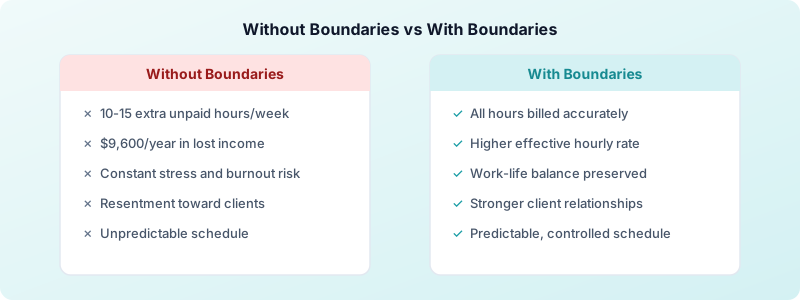
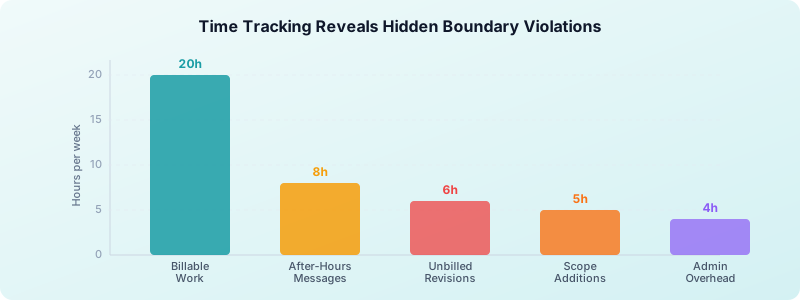
Freelancers without boundaries work an average of 10 to 15 extra hours per week on unplanned tasks and after-hours communication. Over a year, that adds up to 500 to 780 hours of unpaid labor.
Boundaries protect three things:
- Your income. Every unbilled hour lowers your effective rate. If you charge $80 per hour but work 10 free hours per month, you are giving away $9,600 per year.
- Your mental health. Constant availability creates chronic stress. Your brain never fully disconnects, and the quality of both your work and your rest suffers.
- Your client relationships. Counterintuitively, clients respect freelancers who have clear rules. Professionals who set expectations upfront build more trust than those who say yes to everything.
Define Your Non-Negotiable Boundaries
Before you communicate anything to clients, get clear on your own limits. Define your rules when you are calm, then enforce them consistently.
Here are five boundaries every freelancer should establish:
1. Working hours. Pick a start time and an end time. If you work 9 AM to 5 PM, that means you do not respond to client messages at 7 PM. Period. If you work with clients in different time zones, state your hours in your time zone and let them adjust.
2. Communication channels. Pick one or two channels and stick to them. Email and one project management tool is plenty. If a client texts you, reply on email instead.
3. Response time. Tell clients upfront what to expect. "I respond to emails within 24 business hours" is a clear, reasonable standard. This prevents clients from sending follow-ups because they have not heard from you in two hours.
4. Revision limits. Specify the number of revision rounds included in every project. Two rounds is the industry standard. After that, additional revisions are billed at your hourly rate.
5. Scope of work. Every project needs a written scope that defines what is included and what is not. This is your strongest boundary, and it is the one that most directly protects your income. If you have struggled with projects expanding beyond the original agreement, your process for preventing scope creep starts here.
Write these boundaries down. Having them documented makes enforcement ten times easier.
Communicate Boundaries Before the Project Starts
The best time to set boundaries is during onboarding, before any work begins and before the client forms habits around your availability.
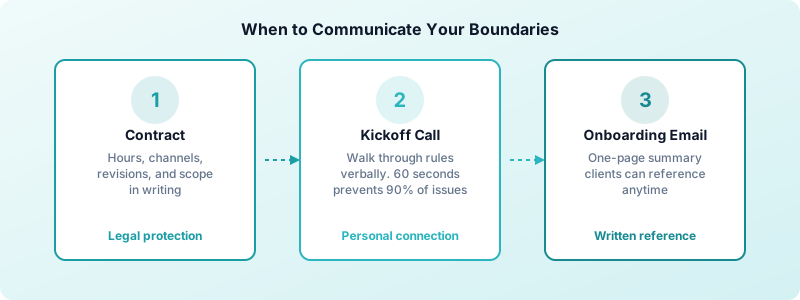
In your proposal or contract: Include a "Working Relationship" section that states your hours, communication channels, response times, and revision policy. When the client signs, they agree to these terms alongside the project scope and budget.
In your kickoff call: Walk through the boundaries verbally. Say something like: "I work Monday through Friday, 9 to 5 Eastern. If you send me something on the weekend, I will get back to you Monday morning." This takes 60 seconds and eliminates 90% of after-hours requests.
In your onboarding email: Send a one-page document summarizing how you work. Include your preferred communication channel, response time, and what to do if something is urgent.
The key principle: frame boundaries as part of your professional process, not as personal preferences. "I do my best work when I can focus during business hours" is stronger than "I do not like getting messages after 5 PM." The first version positions boundaries as something that benefits the client.
If you are building out your client onboarding process, adding a boundaries section takes five minutes and prevents months of frustration.
Enforce Boundaries Without Burning Bridges
Setting boundaries is the easy part. Enforcing them when a high-paying client pushes back is where most freelancers fold. Here are practical strategies for holding your ground without damaging the relationship.
Delay, do not ignore. When a client emails you at 10 PM, do not respond until the next business day. You do not need to explain why. Your consistent behavior trains clients to expect responses during your stated hours. Most clients adjust within two weeks.
Use scripts for common pushback. When a client says "Can you just quickly..." or "This should only take a minute," respond with: "I would be happy to add that. It falls outside the current scope, so I will send over a quick estimate." This redirects the conversation from favors to business.
Separate urgency from importance. Clients often present requests as urgent when they are simply top of mind. Before dropping everything, ask: "What is the deadline for this?" Nine times out of ten, it can wait until your next available slot.
Reinforce boundaries with data. When you track your billable hours across projects, you can show clients exactly how requests affect the timeline. "I have logged 28 of the 30 budgeted hours. Adding this request will push delivery by three days or require a budget adjustment." Facts remove emotion from the conversation.
Know when to fire a client. If a client repeatedly ignores your boundaries after multiple conversations, they do not respect your business. Losing one disrespectful client frees capacity for one who values your work.
Use Time Tracking to Protect Your Boundaries
Boundaries are only as strong as your awareness. If you do not know how much time you spend on each client, you cannot tell when someone is consuming more than their share.
Time tracking turns gut feelings into facts:
- Track communication time. Most freelancers discover they spend 5 to 8 hours per week on client communication alone. Knowing this number helps you batch your communication and set realistic policies.
- Monitor after-hours work. Tag any work done outside your stated hours. If you see a pattern with a specific client, you have the data for a direct conversation.
- Measure scope additions. Track extra requests separately. At month-end, you can see exactly how much unbilled work each client generated.
- Compare planned vs actual hours. If you consistently exceed estimates for one client, their boundary issues are costing you money.
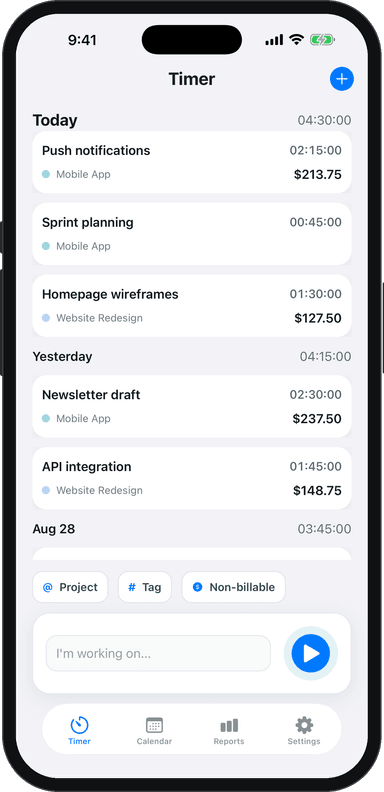
Toggle Time Tracker makes this effortless. Tag each entry by client and project, and your weekly summary shows exactly where your time goes. Because it works offline and requires no account, you can start a timer the instant a client call begins, capturing every minute without friction.
Build Boundaries Into Your Freelance Business
Setting boundaries with freelance clients is not a one-time conversation. It is a system you build into your contracts, your onboarding process, your communication habits, and your time tracking.
Start with one boundary this week. If you do not have set working hours, define them today and add them to your email signature. Small changes compound. Within a month, you will notice less stress, more predictable schedules, and higher effective hourly rates.
If you are managing multiple freelance clients, boundaries become even more critical as each additional client multiplies the potential for schedule conflicts and scope creep.
Download Toggle Time Tracker and start tracking exactly where your time goes so you can set and enforce the boundaries that protect your income and your sanity.