Freelance Tax Deductions: The Complete Guide
Freelance tax deductions are the fastest way to reduce your tax bill without earning less money. As a self-employed worker, you pay taxes on your net profit — income minus expenses — which means every legitimate deduction directly lowers what you owe.
The problem is that most freelancers claim only the obvious ones: maybe a laptop, maybe some software. They leave dozens of freelancer tax write-offs unclaimed, often because they didn't know the expense qualified or didn't have the records to prove it.
This guide covers every major deduction available to freelancers in 2026, what actually qualifies, and how to keep the records that make tax season painless.
Why Freelance Tax Deductions Change Everything
When you work a regular job, your employer handles payroll taxes. As a freelancer, you pay both the employee and employer sides of Social Security and Medicare — a combined self-employment tax rate of 15.3% on top of income tax.
That sounds brutal, but the tax code compensates you in other ways. You can deduct the full cost of running your business: equipment, software, your home office, health insurance, retirement contributions, and more. None of those are available to regular employees.
The result: a freelancer with $80,000 in revenue who claims $20,000 in legitimate deductions pays tax on $60,000. At a 22% effective rate, that's roughly $4,400 in tax savings from deductions alone. Knowing your numbers matters — if you haven't thought through how to set your freelance rates, these deductions change the math significantly.
The Most Valuable Business Expense Deductions
These deductions reduce your Schedule C profit directly, and most freelancers qualify for all of them.
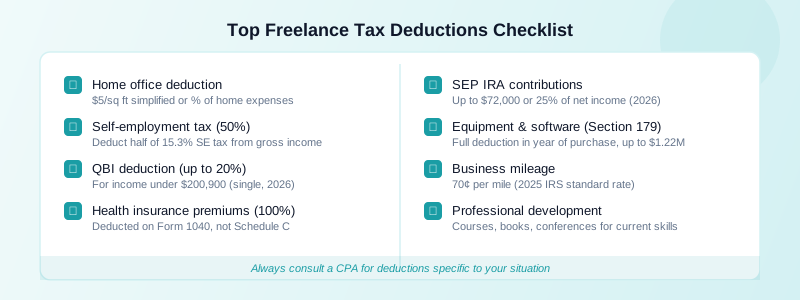
Self-employment tax deduction. You can deduct half of your self-employment taxes from your gross income on Form 1040. This alone reduces your AGI by around 7.65% of your net self-employment income.
Qualified Business Income (QBI) deduction. If your taxable income falls below $200,900 (single) or $401,800 (married filing jointly) in 2026, you can deduct up to 20% of your net business income. This is one of the largest deductions available to freelancers and doesn't require any spending on your part — it's calculated automatically.
Health insurance premiums. Self-employed individuals can deduct 100% of health insurance premiums paid for themselves, a spouse, and dependents. This deduction comes off Form 1040, not Schedule C, but it reduces your taxable income dollar for dollar.
Retirement contributions. Contributions to a SEP IRA are deductible up to 25% of net self-employment income, with a 2026 cap of $72,000. A Solo 401(k) has similar limits. These contributions reduce your taxable income now while growing tax-deferred. See our complete guide to freelance SEP IRA retirement savings for setup steps and how to calculate your contribution.
Equipment and technology. Computers, monitors, cameras, hard drives, and other equipment used for your business are fully deductible. The Section 179 deduction lets you write off the full purchase price in the year you buy the item rather than depreciating it over years. The 2026 limit for Section 179 is $1,220,000 — more than any freelancer will ever spend.
Software and subscriptions. Any tool you use for client work or business operations qualifies: design software, project management tools, accounting apps, cloud storage, stock photo subscriptions, communication platforms. Keep the receipts and note what each one is for.
Professional services. Accountant fees, attorney fees, consultant fees, and payments to subcontractors are all deductible. If you hire a virtual assistant or bring in another freelancer on a project, that cost reduces your taxable income.
Home Office Deduction: What Qualifies and How to Calculate It
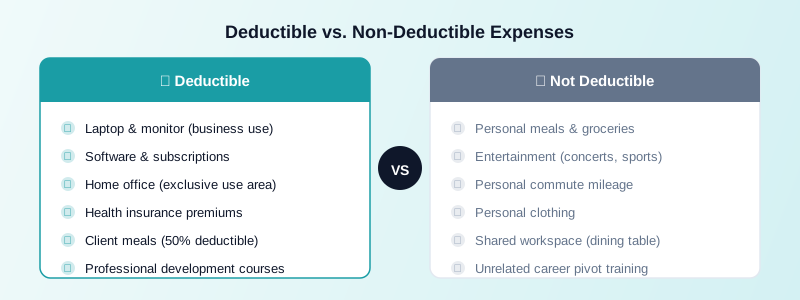
The home office deduction is valuable but requires meeting a specific IRS standard: the space must be used regularly and exclusively for business.
A dedicated room works easily. A desk in a shared living space can qualify too — as long as that area is only used for work. The dining table where you also eat dinner does not qualify.
Simplified method: Deduct $5 per square foot of your home office, up to 300 square feet. Maximum deduction: $1,500. Easy to calculate, minimal documentation needed.
Regular method: Calculate what percentage of your home's total square footage the office occupies. Apply that percentage to all qualifying home expenses: rent or mortgage interest, utilities, homeowner's or renter's insurance, and repairs. If your office is 12% of your home, you deduct 12% of each qualifying expense. This method typically produces a larger deduction but requires keeping more records.
If you rent, the regular method often results in a substantial deduction. If you own your home, it gets more complex because you can also depreciate the business portion — but that has implications when you sell, so talk to an accountant before going that route.
Internet and phone. These aren't bundled into the home office deduction. They're separate deductions. If you use your phone and internet 70% for business, you deduct 70% of each bill. Be realistic about the percentage — the IRS can ask you to justify it.
Tracking Your Deductions Year-Round (Not Just in April)
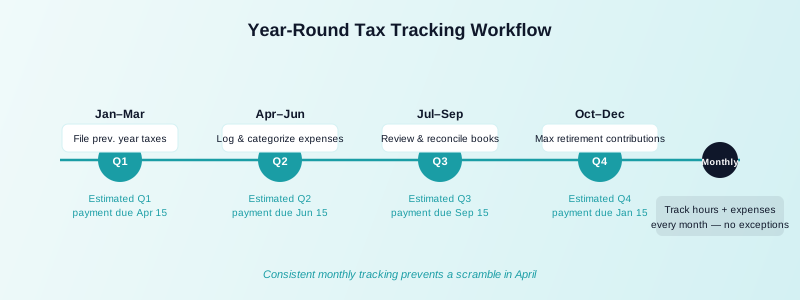
Most freelancers spend hours scrambling through bank statements and receipts each spring. That's the wrong approach — both because it's painful and because you miss things.
The better system is to treat freelance expense tracking as part of your regular workflow. Open a dedicated business checking account and credit card if you haven't already. Run all business purchases through them and your categorization work drops dramatically.
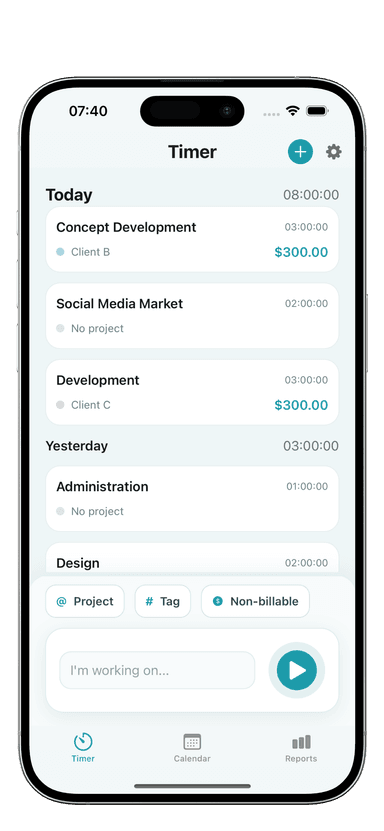
For time-based records, apps like Toggle Time Tracker log your hours by project automatically — which is critical not just for billing clients but for substantiating deductions like the home office (showing you actually work there) and vehicle mileage (showing the business purpose of each trip). When you can track billable hours accurately, you can also see exactly how much time you spend on admin, marketing, and overhead — all legitimate business activities.
Review your expenses monthly. Set aside 20 minutes, match transactions to categories, and flag anything that needs documentation. That's it. By December, your books are clean and tax preparation takes hours instead of days.
Tax Deductions Freelancers Commonly Miss
These are the write-offs that frequently go unclaimed because they're less obvious — but they're all legitimate.
Business meals. Meals with clients or during business travel are 50% deductible. The IRS requires documentation: who was there, what you discussed, and the business purpose. A quick note in your calendar or expense app works fine.
Education and professional development. Courses, workshops, books, and conferences that maintain or improve skills relevant to your current work are deductible. The training has to relate to your existing business — you can't deduct an unrelated career pivot.
Banking fees. Monthly fees, wire transfer fees, and payment processing fees on your business accounts are deductible. If you use PayPal, Stripe, or a similar platform for client payments, those processing fees are a business expense.
Vehicle mileage. If you drive to client meetings, coworking spaces, or business-related errands, you can deduct the mileage. The 2025 IRS standard mileage rate is 70 cents per mile. Track it with a mileage app or a simple log. A 5,000-mile year at 70 cents equals a $3,500 deduction.
Marketing and advertising. Your website, domain registration, hosting fees, any paid advertising, business cards, and portfolio costs all qualify. So do any tools you use specifically for client acquisition.
Coworking space memberships. If you pay for a coworking space, even part-time, that cost is deductible. Keep your membership receipts and be prepared to show the business purpose.
HSA contributions. If you have a high-deductible health plan, contributing to a Health Savings Account (HSA) reduces your taxable income. The 2026 contribution limit is $4,400 for individuals and $8,750 for families, with a $1,000 catch-up if you're 55 or older.
How to Prepare Your Records for Tax Season
Good records don't just help at tax time — they protect you in case of an audit. The IRS can audit returns up to three years back (six years if they suspect significant underreporting), so your documentation needs to last.
What to keep: Receipts and invoices for every business expense. Bank and credit card statements. Your invoices to clients. Contracts and agreements. Mileage logs if you deduct vehicle use. Records of home office square footage.
How long to keep it: At minimum, seven years for anything related to income or deductions. Some records — contracts, property-related documents — should be kept longer.
Digital is fine. Scanned or photographed receipts are acceptable to the IRS. Cloud storage means your records survive a laptop failure. Apps like Toggle Time Tracker export your time and project data, giving you a clean record of business activity that pairs with your financial records. When you also keep your invoicing records organized, you have a complete picture of income and expenses ready for your accountant.
Work with a CPA who knows freelancers. Generic tax preparers miss self-employment-specific deductions regularly. A CPA who works with self-employed clients knows what's available, what documentation you need, and how to structure your finances to minimize taxes legally.
Keep More of What You Earn
Freelance tax deductions aren't a loophole — they're the tax code working as intended. You're allowed to deduct the legitimate costs of running your business. The freelancers who end up overpaying are usually the ones who didn't track their expenses, couldn't find their receipts, or simply didn't know what qualified.
Systematic record-keeping, a dedicated business bank account, and a CPA who understands self-employment are the three things that move the needle most. Combine those with diligent freelance tax deductions tracking throughout the year, and tax season stops being stressful.
Download Toggle Time Tracker to start tracking your hours and projects — your future self at tax time will thank you.