Freelance SEP IRA: Save for Retirement and Cut Your Tax Bill
Most freelancers have no employer setting aside money for their future. No 401(k) match, no pension, no automatic payroll deductions. If you want freelance SEP IRA retirement savings to actually happen, you have to build the system yourself — and the good news is that the IRS gives self-employed people some of the most generous retirement account options available.
A SEP IRA is the simplest and most flexible place to start. It takes about an hour to set up, requires zero ongoing paperwork, and lets you contribute far more than a standard IRA each year. Here's how it works.
Why Most Freelancers Skip Retirement (And Why That's a Mistake)
Freelance income feels unpredictable. When money is tight, retirement saving is the first thing cut. When business is strong, it's easy to assume there will be time to catch up later.
The real cost is compounding. A freelancer who contributes $10,000 per year from age 30 to 60 ends up with roughly $940,000 assuming 7% average annual growth. Starting at 40 instead of 30 cuts that to about $472,000 — the same contributions, half the result.
There's also a tax angle that makes this even more urgent. Every dollar you contribute to a SEP IRA is a dollar off your taxable income. If you're in the 22% federal tax bracket and contribute $20,000, you save $4,400 in federal taxes that year — before even counting self-employment tax savings on top.
Good expense records and time tracking make this easy to plan. When you use Toggle Time Tracker to log your billable hours accurately, you have a clear picture of annual income — which is exactly what you need to calculate how much you can contribute.
What Is a SEP IRA and How Does It Work?
SEP stands for Simplified Employee Pension. It's a retirement account designed specifically for self-employed individuals and small business owners.
Here's the simple version: you contribute money from your business income into an IRA, you get a tax deduction for the contribution, and the money grows tax-deferred until retirement. You pay income tax when you withdraw in retirement — at which point you're likely in a lower tax bracket.
Key characteristics of a SEP IRA:
- You contribute as the employer. Unlike a traditional 401(k), there's no employee "salary deferral" — all contributions come from the business side.
- Contributions are flexible. You decide each year how much to contribute, from 0% to the annual maximum. Bad revenue year? Contribute nothing. Great year? Max it out.
- No annual IRS filings. Unlike some retirement plans, a SEP IRA requires almost no administrative work. No Form 5500, no annual reporting.
- Immediate 100% vesting. The money is yours the moment it's deposited.
- Early withdrawal penalty. Withdrawing before age 59½ triggers a 10% federal penalty on top of ordinary income tax — just like other IRA types.
SEP IRA Contribution Limits for 2026
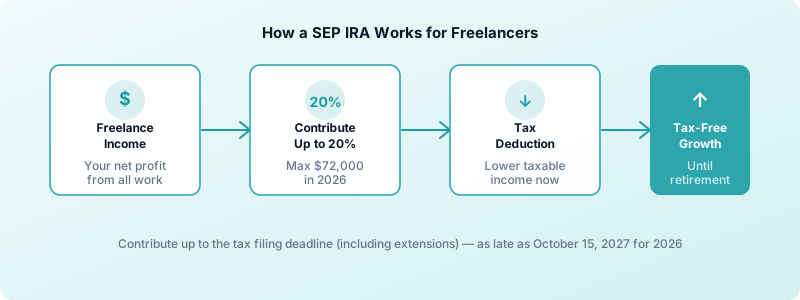
The SEP IRA contribution limit for 2026 is the lesser of 25% of your net self-employment income or $72,000.
There's an important calculation detail here: as a sole proprietor, you contribute based on net profit after subtracting the deductible portion of self-employment tax. In practice, this works out to approximately 20% of your gross net profit.
Some concrete examples for 2026:
| Net self-employment income | Maximum SEP IRA contribution | |---|---| | $50,000 | ~$9,293 | | $100,000 | ~$18,587 | | $150,000 | ~$27,880 | | $200,000 | ~$37,174 | | $360,000+ | $72,000 (maximum) |
You do not need to decide how much to contribute until your tax return is due — including extensions. For most sole proprietors, that's October 15, 2027 for the 2026 tax year. This gives you the full picture of your income before committing to a contribution amount.
One limitation to note: SEP IRAs have no catch-up contributions for those 50 and older. If you're over 50 and want to maximize contributions, a Solo 401(k) may be worth considering (covered below).
How to Set Up a SEP IRA in Three Steps
Opening a SEP IRA is straightforward. Here's the process:
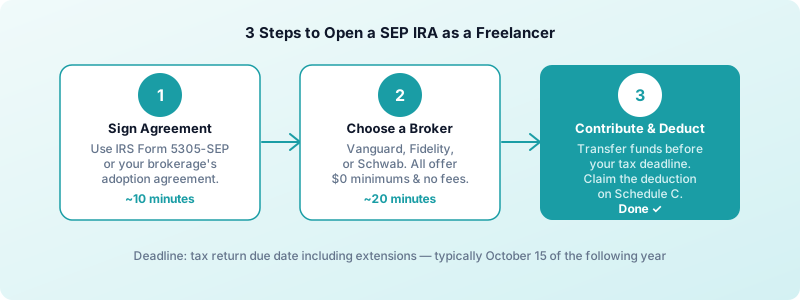
Step 1: Sign a written agreement. The IRS requires a formal adoption agreement. The easiest way is IRS Form 5305-SEP, which is a one-page document. Most financial institutions provide their own version when you open the account — you usually just sign it as part of the application.
Step 2: Choose a financial institution. You can open a SEP IRA at Vanguard, Fidelity, Charles Schwab, or most other brokerages. All three offer $0 account minimums and no account maintenance fees. Look for low-cost index fund options — they keep fees minimal and track the market reliably over the long run.
Step 3: Make your contribution. Once the account is open, you fund it by transferring money from your business bank account. Set up the contribution before your tax filing deadline to claim the deduction for that tax year.
That's it. The total time investment is about 30–60 minutes to open the account. After that, your only task is deciding how much to contribute each year and making the transfer.
SEP IRA vs. Solo 401(k): Which Is Right for You?
If you're a solo freelancer with no employees, you have two strong options. Here's how they compare:
SEP IRA is better if you:
- Want the simplest setup with minimal paperwork
- Have variable income and appreciate contribution flexibility
- Might hire employees in the future (you'd need to contribute the same percentage for them)
- Don't need catch-up contributions
Solo 401(k) is better if you:
- Have lower income but want to maximize contributions (it allows salary deferrals plus employer contributions)
- Are 50+ and want catch-up contributions ($8,000 extra per year)
- Want a Roth option for after-tax contributions
- Are confident you won't hire employees (the Solo 401(k) requires termination if you hire non-spouse employees)
A practical example: a freelancer earning $75,000 net can contribute about $13,940 to a SEP IRA. That same freelancer with a Solo 401(k) could contribute $24,500 as the "employee" plus a profit-sharing contribution — reaching closer to $38,440 total. The Solo 401(k) allows dramatically higher contributions at lower income levels.
For higher earners — $150,000 and above — the gap between the two plans narrows significantly, and the SEP IRA's simplicity often wins out.
Both plans allow a SEP IRA and a Roth IRA in the same year, subject to Roth income limits. That combination can be a smart strategy for tax diversification in retirement.
Start Small, Save Consistently
You don't need to contribute the maximum in year one. Even $5,000–$10,000 in your first year builds the habit and starts compounding.
The most important thing is to treat your SEP IRA contribution like a business expense — something you plan for and fund intentionally, not just what's left over at tax time. Build it into your quarterly financial review alongside your quarterly tax estimates. Our guide to freelance quarterly taxes walks through the timing in detail.
Good financial planning starts with knowing your numbers: how much you've earned, how much you've spent, and how much time you've billed. Toggle Time Tracker keeps the time side accurate — every billable hour logged so your income picture is complete. Pair that with organized records of your expenses (see our freelance expense tracking tips) and you'll have everything you need to calculate your SEP IRA contribution with confidence.
For a full picture of what else you can deduct as a freelancer, see the freelance tax deductions guide. A SEP IRA contribution is one of the largest single deductions available — and unlike most deductions, it's also building your future at the same time.
Download Toggle Time Tracker and build the financial clarity your retirement plan depends on.