How to Calculate Your True Freelance Hourly Rate
Most freelancers pick a number that feels right and call it their hourly rate. Maybe they looked at what competitors charge, or divided their old salary by 2,080 hours. The problem? Both approaches ignore the hidden costs of freelancing — and leave money on the table.
Your true hourly rate isn't what you invoice. It's what you actually earn per hour of work, after accounting for taxes, business expenses, and all the non-billable time that keeps your freelance business running.
Here's how to calculate it properly.
Why most freelancers undercharge
The most common mistake is treating freelance rates like employee salaries. When you worked a salaried job, your employer paid for health insurance, retirement contributions, office space, software, and payroll taxes. As a freelancer, those costs come out of your pocket.
A $50/hour freelance rate is not equivalent to a $50/hour salary. After self-employment taxes (roughly 15% in the US), health insurance, and business expenses, that $50 might be worth $30-35 in take-home pay.
The second mistake is assuming you'll bill 40 hours per week. You won't. Between admin, marketing, invoicing, and client acquisition, most freelancers bill 25-30 hours out of a 40-hour work week. If you set your rate assuming 40 billable hours, you're automatically undercharging by 25-35%. If this sounds familiar, our guide on how to stop undercharging as a freelancer walks through the warning signs and fixes.
The real formula for your freelance hourly rate
Here's the formula that accounts for everything:
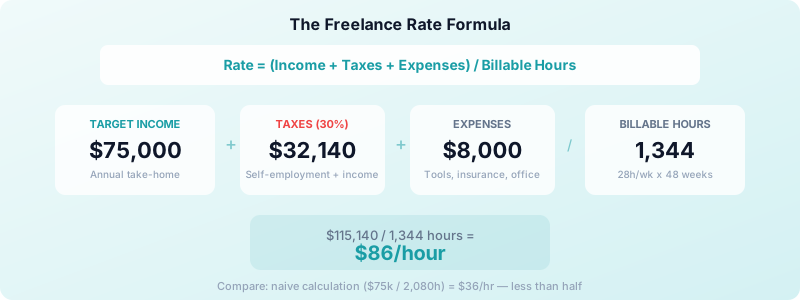
Hourly Rate = (Target Annual Income + Taxes + Expenses) / Annual Billable Hours
Let's break each component down.
Target annual income: What you want to take home after everything. Not revenue — actual income. If you want to earn the equivalent of a $75,000 salary, start with $75,000.
Taxes: As a freelancer, you pay both the employee and employer portions of Social Security and Medicare (about 15.3% in the US), plus federal and state income tax. A safe estimate is 25-35% of your gross income for taxes.
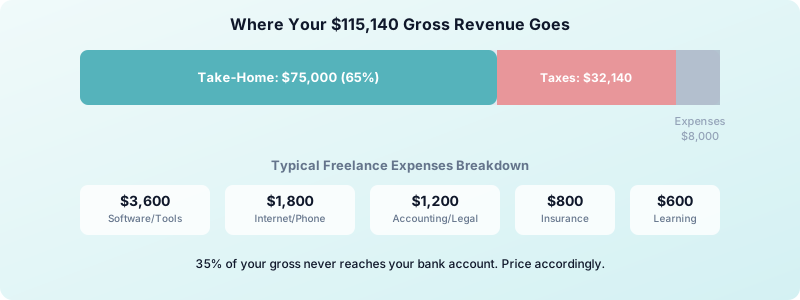
Business expenses: Software subscriptions, hardware, internet, phone, workspace (home office or coworking), professional development, insurance, accounting fees. For most freelancers, this runs $5,000-$15,000 per year.
Annual billable hours: This is where tracking your time becomes essential. Take your realistic weekly billable hours (not total working hours) and multiply by the weeks you plan to work. If you bill 28 hours per week and work 48 weeks per year, that's 1,344 billable hours.
Running the numbers: a real example
Let's calculate a rate for a freelance designer who wants to earn the equivalent of a $75,000 salary:
- Target income: $75,000
- Estimated taxes (30%): $32,140 (calculated on gross)
- Business expenses: $8,000/year
- Total gross needed: $115,140
- Weekly billable hours: 28 (tracked, not guessed)
- Weeks worked per year: 48 (4 weeks off)
- Annual billable hours: 1,344
Rate = $115,140 / 1,344 = $85.65/hour
Round up: $86/hour — or $90 if you want a buffer.
Compare this to the naive calculation: $75,000 / 2,080 hours = $36/hour. That's less than half of what you actually need to charge. The gap is taxes, expenses, and non-billable time — three things most freelancers forget.
Accounting for taxes and business expenses
Taxes are the biggest hidden cost for new freelancers. Here's a rough breakdown for US-based freelancers:
- Self-employment tax: 15.3% (Social Security + Medicare)
- Federal income tax: 12-22% for most freelancers (depending on bracket)
- State income tax: 0-13% depending on your state
The combined rate typically lands between 25-35% of your gross income. If you're outside the US, research your local self-employment tax obligations — they vary significantly.
For expenses, track everything for one quarter and annualize it. Common freelance expenses include:
- Software and tools ($100-500/month)
- Internet and phone ($100-200/month)
- Workspace or home office deduction
- Health insurance premiums
- Professional liability insurance
- Accounting and legal fees
- Hardware depreciation
- Professional development and courses
Many freelancers undercount their expenses because they don't track them systematically. The same discipline you apply to tracking billable hours should apply to tracking expenses.
Factoring in non-billable hours
This is where your rate calculation succeeds or fails. The difference between total working hours and billable hours is the single biggest factor most freelancers miss.
Non-billable time includes everything you do that isn't directly charged to a client: admin, marketing, sales calls, proposals, invoicing, bookkeeping, professional development, and business operations.
For most freelancers, non-billable work consumes 25-35% of total working time. That means out of a 40-hour week, you're realistically billing 26-30 hours.
The only way to know your actual ratio is to track it. Don't guess — guessing consistently leads to undercharging. Use a time tracker for two to four weeks, tagging each entry as billable or non-billable. The data will likely surprise you.
Once you know your real billable ratio, plug it into the formula. If your ratio is 70% billable, use 28 hours per week (not 40) in your calculation.
Benchmarking your rate against the market
After calculating your minimum viable rate, compare it against market rates for your skill set and experience level. Your calculated rate is the floor — you shouldn't charge less than this. But the market may support a higher rate.
Research market rates through:
- Freelance platforms — check posted rates for similar skills (but note these tend to skew lower due to platform competition)
- Industry surveys — many professional associations publish annual rate surveys
- Peer conversations — other freelancers in your network are often willing to share ranges
- Client budgets — if clients accept your rate without negotiation, you may be priced too low
If your calculated rate is $86/hour but the market rate for your experience level is $120/hour, charge $120. The formula gives you the minimum, not the maximum.
If the market rate is below your calculated minimum, you have a business model problem — not a pricing problem. Either reduce expenses, increase your billable ratio, or move into a higher-value niche.
When and how to adjust your rate
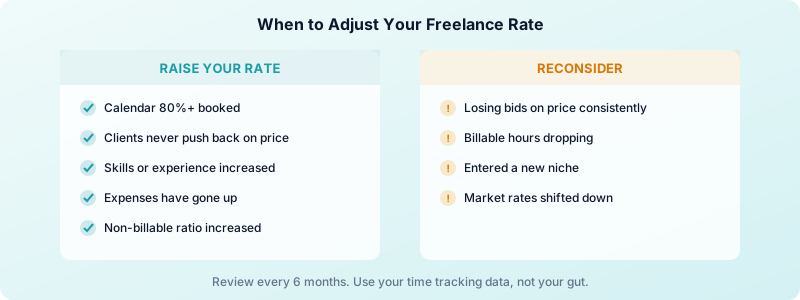
Your rate isn't permanent. Recalculate it every six months using fresh data from your time tracking and expense records. Key triggers for a rate adjustment:
Raise your rate when:
- Your billable calendar is consistently full (80%+ capacity)
- Clients accept your rate without pushback
- Your skills or experience have increased
- Your expenses have gone up (tools, insurance, taxes)
- Your billable ratio has decreased (meaning more non-billable overhead)
Reconsider your rate when:
- You're losing bids consistently on price
- Your billable hours are dropping due to lack of clients
- You've moved into a new niche where you have less experience
The most important input for rate adjustments is your own time data. If you've been tracking consistently, you'll see trends in your billable ratio, project profitability, and time-per-task that inform exactly how much to charge.
Start with real data
The difference between freelancers who earn well and those who struggle often comes down to one thing: they know their numbers. They know their real billable hours, their actual expenses, and their true effective rate — not a guess.
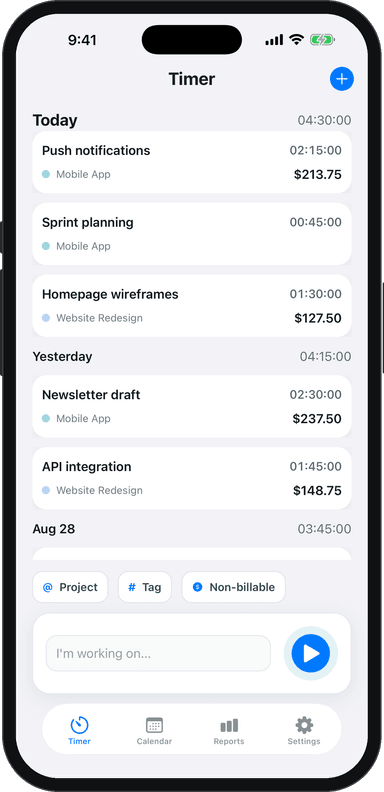
Toggle Time Tracker gives you the data foundation for accurate pricing. Track billable and non-billable hours separately, review your weekly patterns, and export reports that show exactly where your time goes.
Download Toggle Time Tracker and start building the data you need to price yourself right.