The Freelance Retainer Model: How to Set Up Recurring Revenue
If you've been freelancing for more than a few months, you know the feast-or-famine cycle all too well. One month you're turning down work; the next you're refreshing your inbox waiting for a lead. A freelance retainer breaks that cycle by locking in predictable, recurring monthly income from clients who already trust you. Rather than selling your time project by project, you sell ongoing access to your skills — and that changes everything about how you plan, price, and operate.
What a Freelance Retainer Actually Is
A retainer is an agreement where a client pays you a fixed monthly fee in exchange for a defined amount of work or availability. It's not a subscription to your time — it's a structured commitment that benefits both sides. You get stable cash flow; they get priority access to your expertise without re-hiring you each month.
Retainers work best when a client has a recurring need: monthly content, ongoing design updates, regular strategy calls, or continuous technical support. If a client has hired you twice for similar work, that's a strong signal a retainer could serve you both.
Unlike project work, a retainer relationship tends to deepen over time. You learn how the client operates, they trust your judgment more, and the work becomes more efficient — which means you can often deliver more value without significantly increasing your hours.
According to data from Consulting Success, consultants who rely more heavily on retainer arrangements tend to earn more per month than those who stick exclusively to hourly or project-based models. That gap widens as retainer clients refer new work and reduce the time you spend on proposals.
Two Types of Retainer Models (and Which One Is Better)
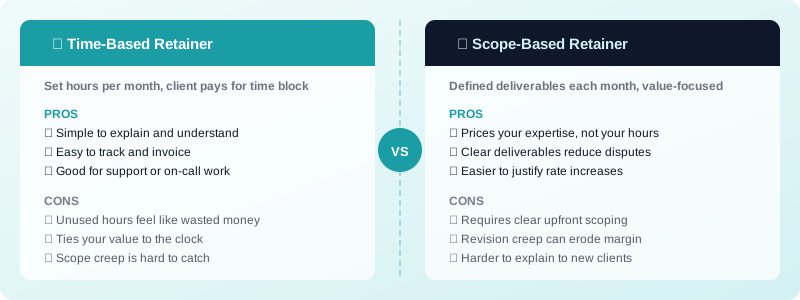
There are two common structures for a freelance retainer agreement, and understanding the difference will help you decide which fits your work.
Time-based retainers charge the client for a fixed number of hours per month. You agree to, say, 20 hours, and they pay for those hours whether they use them all or not. This model is straightforward but can create friction if the client feels they're not getting value from unused hours.
Scope-based retainers define deliverables instead of hours. The client pays for a set output — four blog posts, two design revisions, one monthly strategy session — rather than a block of time. This model is generally better for experienced freelancers because it prices your work on value, not the clock.
If you're just starting with retainers, the scope-based model is worth the extra upfront conversation. It removes the "are you tracking my hours?" anxiety for both sides.
How to Price a Freelance Retainer
Pricing a retainer starts with knowing your true hourly rate. That number is your foundation — you can't build a profitable retainer on top of an hourly rate that already undervalues your work.
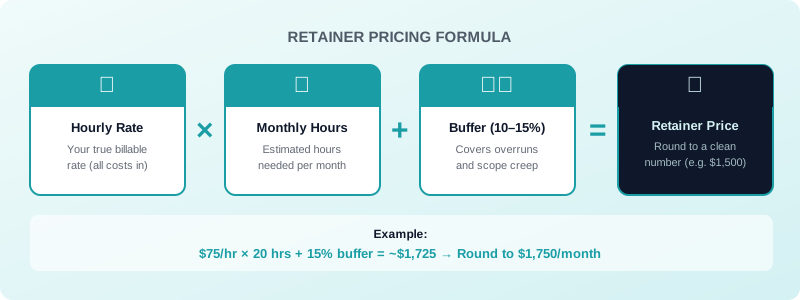
The basic formula is:
Your hourly rate × estimated monthly hours + 10–15% buffer = retainer price
The buffer matters. Retainers often creep beyond scope as the client relationship deepens. Baking in a small overhead protects you without making your price feel inflated. Round to a clean number — $1,500 or $2,000 rather than $1,475 — because cleaner numbers are easier to defend in a pitch.
Consider offering a slight discount (5–10%) compared to your standard hourly or project rate. You're trading a small margin for predictability, and that trade is worth it when it replaces two weeks of uncertain prospecting each month.
If you're still deciding whether retainers make more sense than project work for your practice, it's worth comparing pricing models before you commit to a structure.
How to Pitch a Retainer to an Existing Client
The easiest retainer to land is with a client who's already paid you. Don't cold-pitch the concept — let the relationship do the work.
After completing a project, send a simple follow-up: "I noticed you've come back to me for [X] a few times now. I offer a monthly retainer that would give you priority access to my work and save you the hassle of re-scoping each time. Would that be useful to explore?" That's it. No pressure, no deck required.
When you do discuss terms, be specific about what's included and what isn't. A clear scope protects you from scope creep, and it signals professionalism. Put the agreement in writing — even a one-page email summary counts as a freelance retainer agreement and sets expectations clearly.
Define what happens with unused capacity too. Some freelancers let unused hours roll over for one month; others don't roll over at all. Whatever you decide, write it down so there's no ambiguity later.
Be prepared for clients to ask for a trial month. That's fine. A 30-day test gives both sides a low-risk way to validate the arrangement before committing to a longer term. Set a specific review date at the start so the conversation about continuing — or adjusting the scope — happens naturally rather than getting avoided.
Tracking Time on a Retainer (It Still Matters)
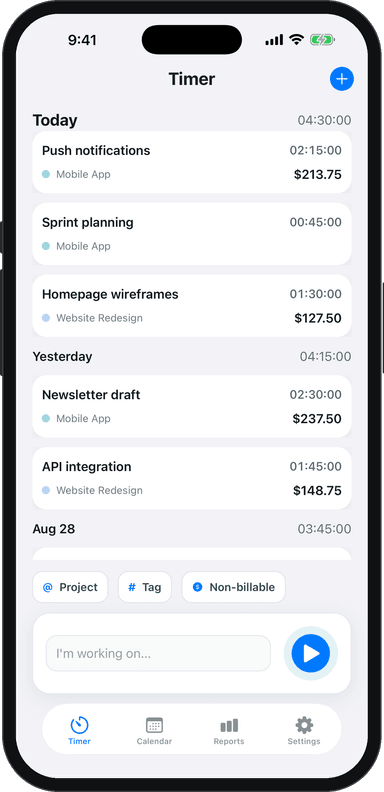
Once you're on a retainer, it's tempting to stop tracking time because you're no longer billing hourly. That's a mistake. Time tracking on a retainer tells you whether you're actually profitable.
If a $2,000/month retainer is consuming 30 hours instead of the 15 you planned, you've effectively halved your rate. You won't catch that problem without data. Use Toggle Time Tracker to log hours by client so you can review your retainer performance at the end of each month and adjust scope or pricing at renewal.
Tracking also gives you leverage in renewal conversations. If you can show a client a breakdown of everything you delivered in the past three months, negotiating a rate increase becomes a straightforward conversation based on evidence rather than a vague ask.
Most retainer problems — undercharging, overdelivering, quiet resentment — trace back to not knowing where the hours actually went. Building a habit of logging time from day one means you always have the data you need to make smart decisions about which retainers to keep, grow, or exit.
When it comes to invoicing retainer clients each month, having accurate time records makes the process faster and gives clients transparency — which builds trust and reduces payment delays.
Recurring revenue is the most durable way to build a freelance practice that doesn't depend on constant selling. Start with one client, structure the agreement clearly, and track your hours so you stay profitable. Download Toggle Time Tracker on the App Store to make sure every retainer you take on actually works in your favor.