Signs You Are Overworking as a Freelancer
Freelancers work an average of 43 hours per week — and nearly one in three regularly exceeds 50. Unlike employees, you have no manager to notice when you are running on empty, no HR policy capping your overtime, and no coworker to share the load. That makes it easy to drift into chronic overwork without realizing it. Knowing the signs you are overworking as a freelancer is the first step toward protecting your health and your income before things get serious.
Why Freelancers Are Especially Prone to Overworking
Two structural forces push freelancers toward too many hours.
Fear of famine. If you have ever lived through a slow month, you know the anxiety it leaves behind. When work is plentiful, you say yes to everything because the memory of an empty pipeline is still fresh. That pattern gradually inflates your hours until working 55 or 60 hours a week starts to feel normal.
Blurry boundaries. When your home is your office and your phone is your timer, work never truly stops. Research from Stanford found that output per hour drops sharply after 50 hours a week, and working 70 hours produces no more than working 55. You can put in the time and still get nothing extra for it — except exhaustion.
Understanding these dynamics helps you recognize the warning signs for what they are: structural problems, not personal failures.
7 Clear Signs You Are Overworking as a Freelancer
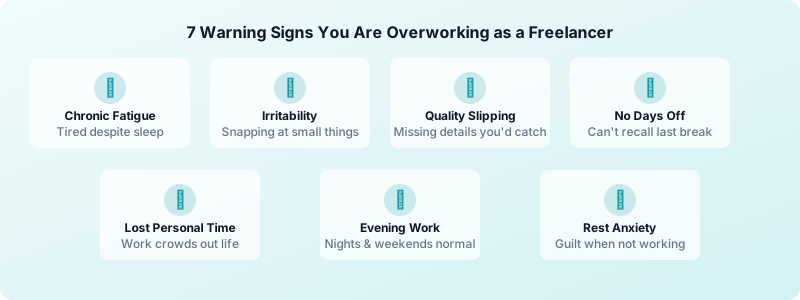
Watch for these patterns in your day-to-day experience.
1. You wake up tired. Chronic fatigue that a full night of sleep does not fix is one of the earliest physical signs of overwork. If you feel depleted before the first task of the day, your body is telling you the current pace is unsustainable.
2. Small things make you snap. Irritability out of proportion to the situation — getting disproportionately frustrated by a minor client revision, a slow internet connection, or a question from a family member — is a strong emotional signal. It means your stress reserves are depleted.
3. Your work quality is slipping. Are you catching mistakes you would have spotted easily three months ago? Delivering work that feels rushed even on projects you care about? Cognitive performance falls measurably under chronic overload. Declining quality is not a motivation problem; it is a capacity problem.
4. You cannot remember when you last took a full day off. A study of freelancers found that 10% did not take any leave in the past year, and 78% worked during holidays. If you struggle to name a recent day where you genuinely disconnected, you are running without recovery.
5. Work has eaten your personal time. Think about the last week. Did you have time for exercise, hobbies, or seeing people you care about? If work has crowded those things out, your work-life balance is already compromised.
6. You are regularly working evenings and weekends. A late evening occasionally is normal. Every evening is a pattern. If you have normalized working outside your original hours, the workload has exceeded your actual capacity.
7. You feel anxious when you are not working. If resting feels like falling behind — if you reach for your phone to check messages during dinner or feel guilt during a walk — you have developed a compulsive relationship with work that will accelerate toward burnout.
What Your Time Data Reveals About Overwork
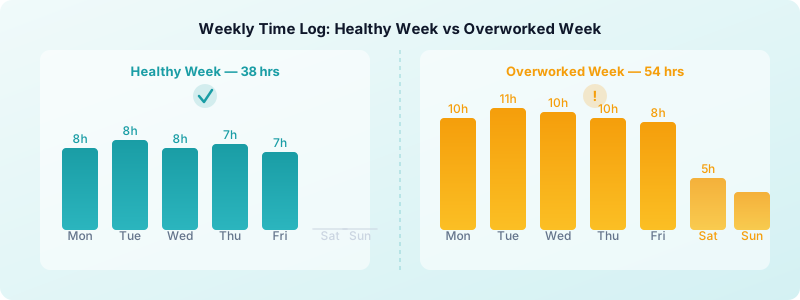
Most freelancers feel the signs above long before they act on them. The reason is that feelings are easy to rationalize away. Data is harder to dismiss.
When you track your hours consistently, you build an objective record of your actual working patterns. Here is what to look for:
- Weekly totals creeping up. If your logged hours climb from 38 to 43 to 50 over six weeks, you are on a trajectory that leads somewhere you do not want to go — even if each individual week felt manageable.
- Evening and weekend log entries appearing regularly. Your time log does not know you told yourself you were "just finishing one thing." It records when you worked. If the timestamps consistently show 9pm or Sunday morning, the boundary has eroded.
- Unbillable hours expanding. When your total hours rise but your billable ratio falls, you are spending more time on admin, scope creep, and rework. That is a sign of disorganization caused by overload.
- One client dominating your hours. If a single client accounts for more than 50% of your weekly tracked time, and that client is also stressful to work with, you have a concentration risk that is amplifying every other pressure.
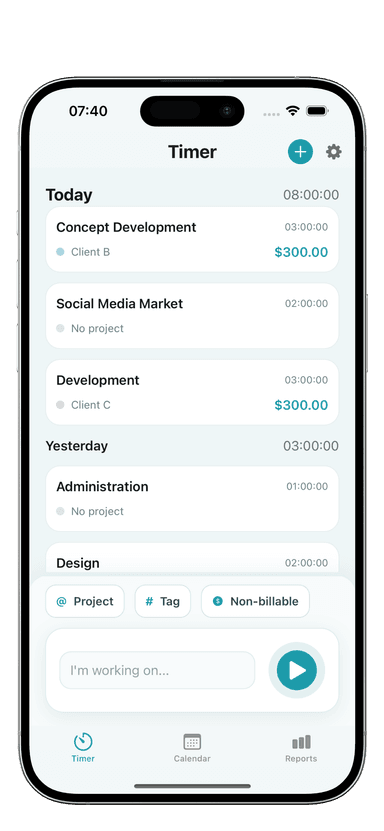
Toggle Time Tracker makes this kind of pattern-monitoring simple. Log your time by project with a single tap, then review your weekly report every Sunday. Because it stores data locally on your device and works offline, there is no friction between deciding to track and actually doing it. The weekly report becomes your early warning system.
How to Course-Correct Before Burnout Sets In
Recognizing the signs early gives you options. Waiting until burnout forces a stop gives you none.
Cut one commitment. Identify the client, project, or task that is consuming the most hours relative to its value. Drop it, raise the rate, or renegotiate the scope. One targeted reduction often frees up 8-10 hours per week.
Set a hard stop time and enforce it. Pick the time you will close your laptop each day and treat it like a client deadline. A shutdown ritual — a brief end-of-day review that signals work is done — helps make the boundary real rather than aspirational.
Protect at least one day per week. Fully off. No checking messages, no "quick tasks," no catching up. Recovery requires genuine rest, not lighter work. If this feels impossible, that itself is a sign of how much course-correction you need.
Use your time data to set a weekly hour cap. Look at your last four weeks of logs. Find a sustainable weekly total — one where your energy held up and your work quality was good. Set that as your ceiling, not your floor. Review it every Sunday. For the full playbook on enforcing that limit, see our guide on how to stop working overtime as a freelancer.
The freelancers who avoid the worst of overwork and burnout are not the ones with fewer clients or easier projects. They are the ones who track what they are doing, notice the signals early, and take action before exhaustion makes the decision for them. For more practical strategies on sustainable freelance work-life balance, building a schedule that protects your energy is what keeps your business running long-term.
Download Toggle Time Tracker and start logging your hours this week. A few weeks of honest data will tell you more about whether you are overworking than any amount of self-assessment.