7 Time Tracking Mistakes That Cost Freelancers Money
Most freelancers don't lose money because their rates are too low. They lose it through silent, compounding time tracking mistakes that add up to thousands of dollars each year. A missed 15-minute task here, a forgotten email there — these tiny gaps are invisible in the moment but devastating over 12 months.
Here are the seven most common time tracking mistakes freelancers make, and how to fix each one.
1. Logging time at the end of the day
This is the most widespread mistake, and it's costing you more than you think. When you wait until 5pm to reconstruct your day, you're relying on memory — and memory is unreliable.
You'll forget the 20-minute client call. You'll underestimate how long the revision cycle took. You'll round down because you're unsure.
The fix: Track in real time. Start a timer when you begin each task. Freelancers who track billable hours in real time consistently log 15-20% more billable time — not because they work more, but because they capture everything.
2. Forgetting to track small tasks
That quick email reply? Five minutes. The Slack message clarifying a deliverable? Three minutes. Reviewing a client's brief before a call? Ten minutes.
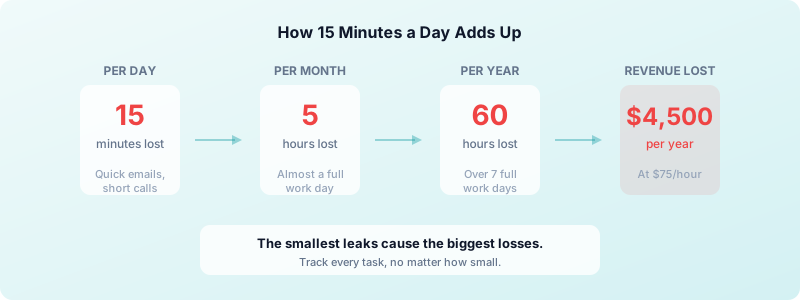
Individually, these seem too small to track. But they add up fast. If you miss just 15 minutes of billable time per day, that's 5 hours per month. At $75/hour, that's $4,500 per year — gone.
The fix: Track everything, even if it feels trivial. A one-tap timer makes this effortless. If it's work for a client, it's billable.
3. Not separating billable from non-billable time
Many freelancers track only their billable hours. That's a mistake. If you don't know how much time goes to admin, marketing, invoicing, and sales, you can't price your services accurately.
Here's why it matters: if you bill 30 hours per week but actually work 45, your effective hourly rate is 33% lower than you think. A $100/hour freelancer is really earning $67/hour.
The fix: Track both types of time. Use separate projects or tags for non-billable work. This data is essential for understanding your true hourly rate and pricing your services correctly.
4. Using spreadsheets instead of a dedicated tool
Spreadsheets feel simple, but they're a trap. Manual entry depends entirely on your memory and discipline. There's no timer, no reminders, and no way to generate client-ready reports.
The real cost isn't just inaccuracy — it's the time you spend maintaining the spreadsheet itself. That's non-billable admin time that a proper tool eliminates.
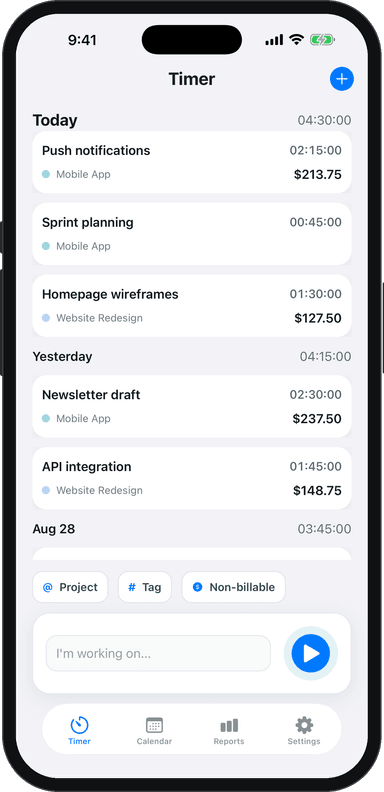
The fix: Switch to a dedicated time tracking app. It takes one tap to start and stop. Your data is organized, searchable, and exportable. Toggle Time Tracker gives you all of this for free, right from your iPhone.
5. Never reviewing your time data
Tracking time is step one. Reviewing it is where the real value lives. Yet most freelancers never look at their data beyond generating an invoice.
Your time logs contain patterns you can't see in the moment. Which clients take more time than they pay for? Which tasks consistently run over estimate? When during the day are you most productive?
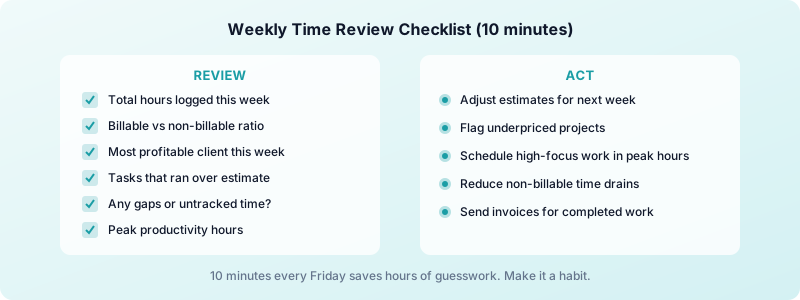
The fix: Set a weekly 10-minute review. Look at your tracked hours from the past week. Ask yourself: where did my time actually go? Which projects were profitable? Where did I lose time? These insights compound over months.
6. Not accounting for admin time in your rate
If you set your rate based on 40 billable hours per week, you're already undercharging. The reality is that freelancers spend 25-35% of their working time on non-billable tasks: invoicing, bookkeeping, marketing, client acquisition, and project management.
That means a 40-hour work week might only yield 26-30 billable hours. If you don't factor this into your rate, you're subsidizing your admin time from your own pocket.
The fix: Calculate your rate based on realistic billable hours, not total working hours. If you need to earn $6,000/month and you can realistically bill 100 hours, your rate needs to be $60/hour — not the $37.50 you'd get by dividing by 160 total hours. Better time management habits can also help you reduce non-billable overhead and reclaim more hours for client work.
7. Skipping time tracking for fixed-price projects
Many freelancers only track time when they bill hourly. For fixed-price or retainer projects, they don't bother. This is a costly blind spot.
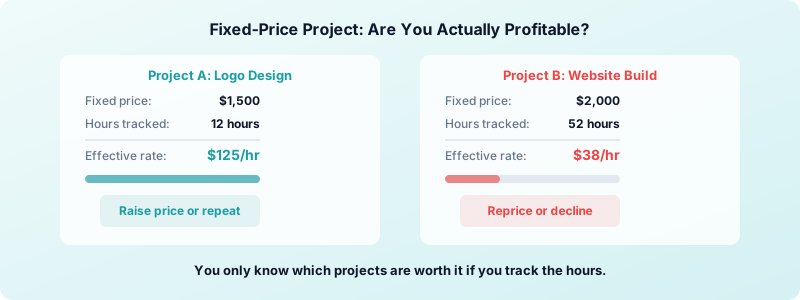
Without tracking fixed-price projects, you have no idea if they're actually profitable. That $2,000 website project might have taken you 50 hours — making your effective rate $40/hour. Or it might have taken 15 hours, meaning you should raise your project price.
The fix: Track every project, regardless of billing method. Fixed-price tracking won't appear on your invoice, but it tells you which projects are worth taking and which ones are draining your income.
The common thread
Every mistake on this list has the same root cause: invisible time leaks. They're small enough to ignore in the moment but large enough to cost thousands over a year.
The solution is simple. Track your time consistently, review it regularly, and use the data to make better decisions about your rates, clients, and workflow.
Download Toggle Time Tracker and start plugging the leaks today. It's free, works offline, and keeps all your data private on your device.