How to Stop Undercharging as a Freelancer
If you have ever finished a project and felt like the pay did not match the effort, you are not alone. Most freelancers undercharge by 30-50% in their first year, and many never correct it. Learning how to stop undercharging as a freelancer starts with understanding why it happens and building a system to prevent it.
The good news: this is fixable. You do not need to become a pricing expert overnight. You need a clear formula, a few warning signs to watch for, and the confidence to act on what the numbers tell you.
Why Freelancers Undercharge (And Why It Hurts)
Undercharging is not humility. It is a business problem that compounds over time. When you charge too little, you attract price-sensitive clients, work longer hours to hit income goals, and eventually burn out.
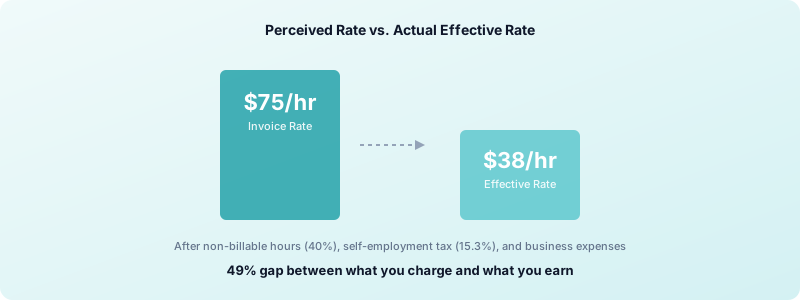
Here is the math that most freelancers miss: if only 50-60% of your working hours are billable (the rest goes to emails, admin, marketing, and invoicing), then a $50/hour rate on your invoice means you are actually earning $25-30/hour. Factor in self-employment taxes of 15.3% and business expenses, and that number drops even further.
The freelancers who calculate their true hourly rate early avoid this trap entirely. Those who guess at pricing end up subsidizing their clients' businesses at their own expense.
5 Warning Signs You Are Undercharging
Before you can fix the problem, you need to spot it. Here are the clearest signals:
-
Nobody pushes back on your rates. A 100% close rate on proposals sounds great until you realize it means you are the cheapest option. Experienced freelancers with fair pricing typically close 25-40% of proposals.
-
You are working long hours just to pay bills. If 50-hour weeks barely cover your expenses, your rate is the problem, not your work ethic.
-
You feel resentment toward projects. There is a difference between procrastination and genuine resentment. If you dread opening a project file, compensation is often the real issue.
-
Your clients seem too focused on price. Clients who choose you primarily because you are the cheapest will always push for more at the same rate. Quality-focused clients rarely haggle on reasonable pricing.
-
Your rates have not changed in over a year. Your skills improve every year. If your rates stay flat while your expertise grows, you are falling behind.
If two or more of these sound familiar, it is time to recalculate.
How to Calculate Your True Minimum Rate
Stop guessing. Use this formula:
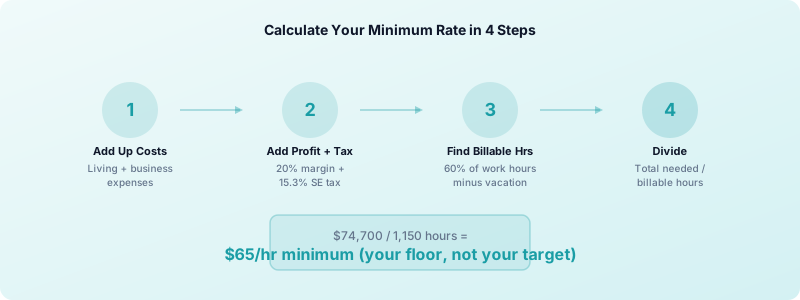
Minimum hourly rate = (Annual expenses + Desired profit + Taxes) / Annual billable hours
Here is a practical example:
- Annual living expenses: $48,000
- Business expenses (software, equipment, insurance): $6,000
- Desired profit margin (20%): $10,800
- Self-employment taxes (~15.3% of income): $9,900
- Total needed: $74,700
Now divide by your realistic billable hours. If you work 40 hours per week but only 24 are billable (60%), that is roughly 1,150 billable hours per year (accounting for vacation and sick days).
$74,700 / 1,150 = $65/hour minimum
That is your floor, not your target. Your actual rate should be 20-30% above this number to account for slow months and unexpected expenses.
Practical Steps to Raise Your Rates
Knowing your number is one step. Acting on it is another. Here is how to make the transition without losing clients:
For new clients: Raise your rate immediately by 15-25%. New clients have no baseline to compare against, so this is the easiest adjustment.
For existing clients: Give 30-60 days notice of a 10-15% increase. Frame it around the value you have delivered. Most clients who have seen quality work will accept reasonable increases. If you need guidance on this conversation, read our guide on when to raise your freelance rates.
Scope adjustments over rate cuts: If a client cannot afford your full rate, remove deliverables instead of lowering your price. A $12,000 project can become an $8,000 project with fewer features. Your per-hour value stays intact.
Track every hour to build evidence. When you track your time on projects, you build a data set that shows exactly how long tasks take. This eliminates guesswork when quoting future projects. Toggle Time Tracker makes this easy with one-tap timers and project-level organization, so you can see exactly where your hours go.
Stop Attracting the Wrong Clients
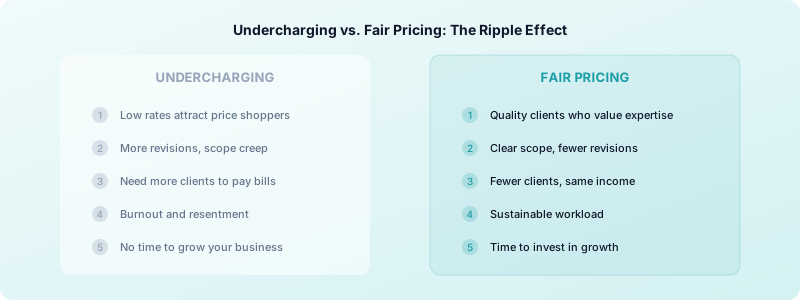
Pricing is also a filter. Low rates attract low-budget clients who prioritize cost over quality. These clients tend to request more revisions, push scope boundaries, and negotiate harder on every invoice.
When you raise your rates, something counterintuitive happens: you start attracting better clients. Clients who pay fair rates value expertise, respect timelines, and are easier to work with. They have usually been burned by cheap work before and want someone reliable.
Here are three shifts to make:
- Lead with results, not hours. Instead of quoting "20 hours at $X," describe the outcome: "A complete website redesign that increases your conversion rate."
- Show your process. Clients pay more when they understand the skill and effort behind the work. Share your workflow during proposals.
- Set minimums. Establish a project minimum (such as $500 or $1,000) that filters out clients who cannot afford professional-level work.
Use Time Data to Price With Confidence
The freelancers who charge accurately share one habit: they track their time on every project, even fixed-price ones. Time data removes emotion from pricing decisions. Instead of wondering whether $3,000 is fair for a project, you can check your records and confirm that similar projects took 40 hours, making $75/hour your baseline.
This is where a simple time tracker pays for itself. With Toggle Time Tracker, you can tag entries by project and client, then export reports that show exactly how profitable each engagement was. Over time, you build a pricing database that makes future quoting fast and accurate.
Understanding the difference between billable and non-billable hours is critical here. If you only track billable time, you miss the admin overhead that should be factored into your rate.
Your Next Steps
Undercharging is not a personality trait. It is a gap between what you know about your costs and what you charge. Close that gap with three actions this week:
- Calculate your true minimum rate using the formula above
- Start tracking every hour on every project for the next 30 days
- Raise your rate for the next new client by at least 15%
Download Toggle Time Tracker and start building the time data you need to price with confidence.