Billable vs Non-Billable Hours: What Freelancers Need to Know
Every freelancer has two types of working hours: the ones you can charge for and the ones you can't. Understanding the difference between billable and non-billable hours isn't just an accounting exercise — it's the foundation of sustainable freelance pricing.
If you only track billable time, you're seeing half the picture. The other half is quietly eating into your income.
What counts as billable time?
Billable hours are any time spent directly on client work that you can charge for. This includes:
- Active project work — design, development, writing, consulting
- Client meetings — calls, presentations, feedback sessions
- Project-specific research — learning tools or topics needed for a deliverable
- Revisions — changes requested by the client within the agreed scope
- Communication — emails and messages about specific project tasks
The key question: would this work not exist without this client? If yes, it's billable.
What counts as non-billable time?
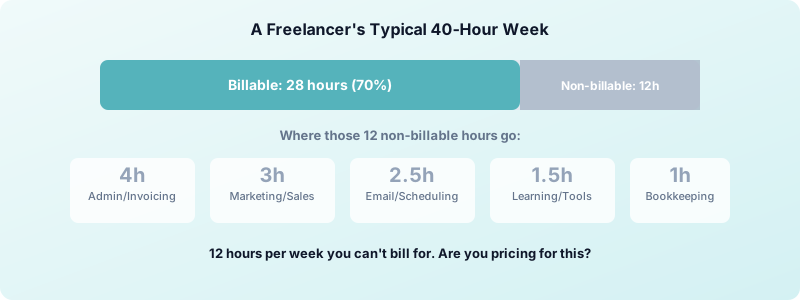
Non-billable time is everything else you do to keep your freelance business running. It's real work, but no client pays for it directly:
- Admin — invoicing, bookkeeping, filing taxes, organizing files
- Marketing — updating your portfolio, writing proposals, social media
- Sales — discovery calls, pitching, following up on leads
- Professional development — courses, reading, skill-building
- Business operations — tool setup, software updates, email management
Most freelancers vastly underestimate how much non-billable time they accumulate each week.
Why tracking both types matters
Here's the math that changes how freelancers think about pricing.
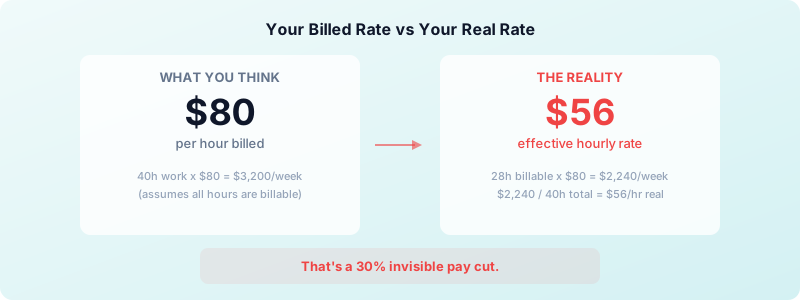
Say you work 40 hours per week and bill at $80/hour. If all 40 hours were billable, you'd earn $3,200 per week. But freelancers typically spend 25-35% of their time on non-billable work.
At 30% non-billable time, you're only billing 28 hours. That's $2,240 per week — not $3,200. Your effective hourly rate drops to $56.
That's a 30% pay cut you gave yourself by not accounting for overhead time.
The only way to see this gap is to track both types of hours. When you know your real billable ratio, you can set rates that actually cover all your working time.
Common non-billable tasks freelancers overlook
Some non-billable time is obvious — invoicing, taxes, marketing. But several categories hide in plain sight:
Context switching. Moving between client projects costs mental energy and transition time. Those 5-10 minute gaps between tasks are non-billable dead zones.
Scope creep management. Time spent negotiating scope changes, writing change-order emails, or redoing work because of unclear briefs. Unless you explicitly bill for this, it's overhead.
Tool maintenance. Updating software, organizing your file system, setting up new project templates. Essential but never invoiced.
Unpaid revisions. If a client asks for changes beyond the agreed scope and you don't charge for them, that's non-billable time masquerading as client work.
Administrative communication. Scheduling meetings, sending reminders, chasing late payments. It's client-related but rarely billed.
Wondering how your week compares? Freelancer work hours per week looks at what freelancers actually work versus what they bill.
How to minimize non-billable time
You'll never eliminate non-billable time entirely — and you shouldn't try. But you can reduce it:
Batch admin tasks. Set one day per week (or a specific time block) for invoicing, emails, and bookkeeping. Batching prevents these tasks from interrupting your billable work.
Use templates. Proposal templates, contract templates, and email templates save hours each month. Build them once, reuse them forever.
Automate where possible. Recurring invoices, automatic time tracking, and scheduled social media posts all reduce manual non-billable work.
Set boundaries. Limit discovery calls to 30 minutes. Require briefs in writing before starting work. Define revision limits in your contracts.
Track to identify patterns. When you understand where your time goes, you spot which non-billable tasks are consuming the most hours — and which ones you can cut.
Non-billable time expands to fill an undefined workday. How to set work hours as a freelancer covers where to put the edges.
Building non-billable time into your pricing
The sustainable approach: accept that non-billable time exists and price accordingly. For a complete walkthrough of building a rate that covers all your costs, see the freelance pricing guide.
Here's a simple formula:
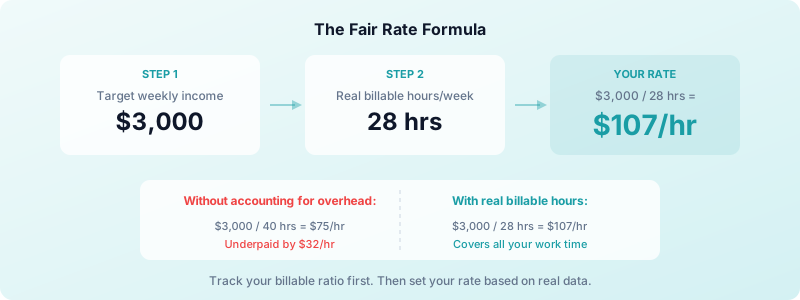
- Decide your target weekly income (e.g., $3,000)
- Track your average billable hours per week (e.g., 28 hours)
- Divide income by billable hours ($3,000 / 28 = $107/hour)
That $107/hour rate covers both your billable and non-billable time. It's higher than the $75/hour you might charge if you assumed 40 billable hours — but it's the rate that actually pays you fairly.
Start tracking both today
The freelancers who earn the most per hour aren't necessarily the most talented — they're the ones who understand their numbers. And the most important number is the ratio between billable and non-billable time.
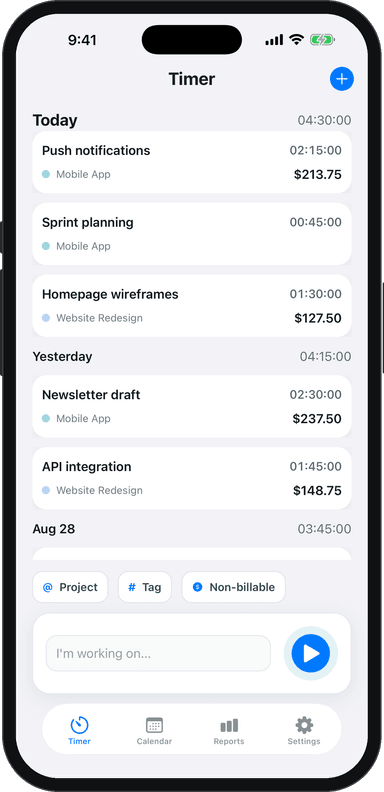
Toggle Time Tracker makes this easy. Tag your time entries as billable or non-billable, and the app calculates your real ratio automatically. No spreadsheets, no guesswork.
Download Toggle Time Tracker and find out what your time is really worth.