How to Price Your Freelance Services
Knowing how to price freelance services is one of the hardest skills to develop — and one of the most important. Most freelancers either set rates too low (based on what feels safe) or copy what someone else charges without accounting for their own costs, skill level, or market position.
The result? Years of undercharging, overworking, and wondering why the income never matches the effort.
This guide walks you through the three core pricing models, how to choose the right one for each project, and how to build a pricing strategy that actually supports the business you want.
Why Most Freelancers Price Themselves Wrong
The most common mistake is confusing your rate with your value. Pricing based on what you think the client will accept — or what you'd be "embarrassed" to charge — is a trap. It anchors your income to your insecurities rather than the market.
A second common error is ignoring the full cost of freelancing. Unlike a salaried employee, you pay your own taxes (roughly 15% self-employment tax in the US on top of income tax), cover your own health insurance, buy your own tools, and handle unpaid admin time. A rate that looks competitive often isn't once you do the math.
The third mistake is treating all projects the same. A well-defined, two-week website project should be priced differently than an open-ended consulting relationship. Using the same pricing model for everything guarantees you'll lose money on some projects and leave it on the table on others.
The Three Core Freelance Pricing Models
Understanding the options is the foundation of knowing how to price freelance services well.
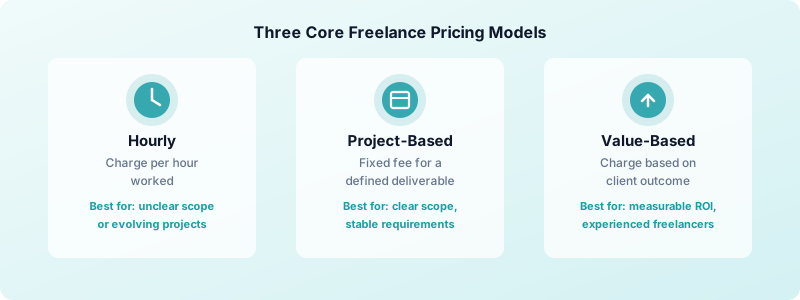
Hourly pricing is the simplest starting point. You agree on a rate, track your time, and invoice for hours worked. It protects you if scope expands unexpectedly — you get paid for every hour regardless of how long the project takes.
The downside: as you get faster and more skilled, hourly pricing penalizes you. A task that took you eight hours two years ago might take two hours now. If you're charging by the hour, you earn 75% less for the same result. It also ties income directly to time, making it hard to scale.
Project-based pricing means charging a flat fee for a defined deliverable. The client knows the cost upfront; you know exactly what you're getting paid. When scope is clear and stable, this model rewards efficiency — if you finish in half the expected time, you still earn the full fee.
The risk: scope creep. A project-based contract without clear boundaries can balloon into far more work than you priced for. Always define deliverables, revision limits, and what's out of scope in writing before work begins.
Value-based pricing charges based on the outcome you deliver, not the time you spend or deliverables you produce. If your work generates $50,000 in new revenue for a client, charging $5,000 for it is reasonable — regardless of whether it took you 10 hours or 100.
Value-based pricing requires confidence and a track record. You need to understand the client's business well enough to quantify your impact. It's not the right model for every project, but it's the highest-leverage option for experienced freelancers who can demonstrate measurable results.
How to Choose the Right Pricing Model for Each Project
No single model works for everything. Here's how to match the model to the situation:
Use hourly pricing when:
- Scope is undefined or likely to change
- The client needs ongoing, flexible support
- You're working in a new niche and still calibrating how long tasks take
- You want maximum protection against scope expansion
Use project-based pricing when:
- Deliverables are clearly defined upfront
- You have strong experience estimating time for this type of work
- The client needs certainty around their budget
- You're confident you can scope the project accurately
Use value-based pricing when:
- You can directly connect your work to a measurable business outcome
- You have a track record in the niche and established credibility
- The client is revenue-focused and thinks in ROI terms
- The project has clear success metrics both parties can agree on
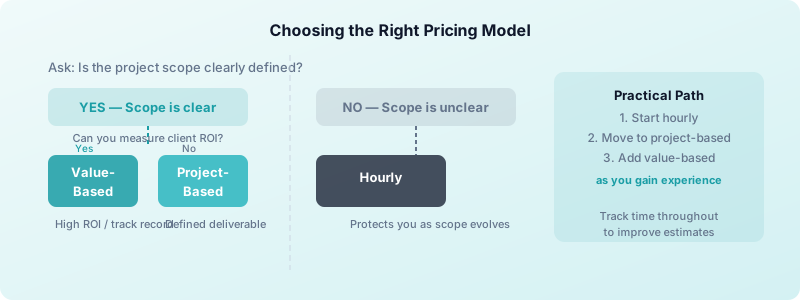
For most freelancers, the practical path is: start with hourly pricing to protect yourself while you're learning, shift to project-based as you gain experience estimating your own work, and layer in value-based pricing once you have the track record to back it up.
If you're working on an hourly basis, Toggle Time Tracker makes it easy to log every minute accurately — so you never under-invoice for time you actually worked. With one-tap tracking and per-project reports, you get clean data to send with every invoice.
How to Research What the Market Pays
Once you've chosen a pricing model, you need to know what rates the market supports. Guessing based on your gut or copying a random forum post isn't a strategy.
Start with your minimum viable rate. Calculate what you need to earn to cover your income goal, taxes, and expenses — then divide by your realistic billable hours. This is your floor. Our guide on calculating your true hourly rate walks through the exact formula, including the self-employment tax adjustment most freelancers forget.
Research market rates. Check platforms like Upwork and Contra for rates in your niche and experience bracket. Look at what peers charge in professional communities (Slack groups, Discords, LinkedIn). Industry surveys from organizations like the Graphic Artists Guild or Writers' Market also publish rate benchmarks by specialty.
Understand the range, not just the average. Rates vary enormously by client type (startup vs enterprise), geography, niche specialization, and deliverable complexity. A "web developer" rate can range from $40/hour to $250/hour depending on these factors. Know where your combination of skills, experience, and client base places you.
Adjust for your situation. If you're newer, accept that you'll start below market rate — but treat it as temporary. Build a plan to raise rates every 6-12 months as you accumulate proof of your value. Our post on when to raise your freelance rates covers the signals that tell you it's time.
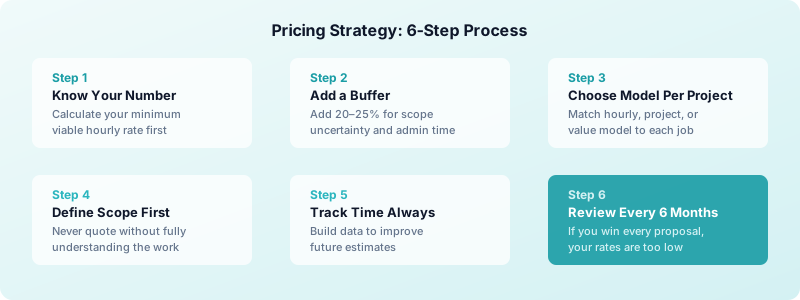
How to Price Freelance Services: A Step-by-Step Strategy
Setting up a reliable pricing system means you stop guessing with every proposal and start applying a consistent framework.
Step 1: Know your number. Calculate your minimum viable rate for hourly work. This is non-negotiable — any project where you earn below this rate is costing you money.
Step 2: Add a buffer. Your minimum rate assumes everything goes smoothly. It rarely does. Add 20-25% to account for scope uncertainty, revision rounds, and admin time you'll inevitably spend.
Step 3: Choose the model per project. Run through the hourly/project/value framework for each new opportunity. Don't default to one model for everything.
Step 4: Define scope before you quote. Never quote a project before you fully understand what's included. Scope creep is the single biggest reason freelancers lose money on fixed-price work. Our guide on hourly vs project-based pricing covers how to scope projects accurately for each model.
Step 5: Track your time on every project. Even on fixed-price work, track your hours. This builds a personal database of how long tasks actually take — which directly improves your future estimates. Over time, it also tells you your effective hourly rate on project work, so you can identify which clients and project types are actually profitable.
Step 6: Review and adjust regularly. Prices aren't permanent. Review your rates every six months. If you're winning every single proposal without negotiation, your prices are probably too low. If you're winning 20-30% of proposals, you're likely in the right range.
Pricing well isn't about charging as much as possible — it's about charging accurately for the value you deliver and the costs you carry. Once you have a system for it, you stop second-guessing every proposal and start approaching new projects with confidence.
Download Toggle Time Tracker and start building the time data that makes your future pricing decisions easier and more accurate.