How to Estimate Freelance Project Time More Accurately
If you've ever finished a project and realized you drastically undercharged, you already know how painful it is to estimate freelance project time badly. You quoted 10 hours. It took 18. The client is happy — but your effective hourly rate just collapsed.
The good news: estimation is a skill you can improve with the right system. Here's how to build one.
Why Freelancers Consistently Underestimate Projects
The average freelancer doesn't underestimate because they're careless. They underestimate because estimating is genuinely hard, and most of us only think about the visible work.
You picture yourself writing the copy, designing the screens, or building the feature. What you forget are the invisible hours: client feedback rounds, file organization, exporting deliverables, fixing that one weird bug, and re-reading the brief three times because the requirements shifted.
Research by the Project Management Institute found that inaccurate time estimates are a primary cause in 25% of failed projects. And a 1994 study on thesis completion found that students underestimated their completion time by an average of 40% — even when they imagined a worst-case scenario. The actual average was 55.5 days against a predicted 33.9.
Good freelance time management starts with honest estimation, not optimistic guessing.
The Planning Fallacy: What's Working Against You
The planning fallacy is a cognitive bias first described by psychologists Daniel Kahneman and Amos Tversky in 1979. It explains why humans consistently underestimate how long tasks will take — even on tasks they've done many times before.
The core problem: when you imagine a future project, your brain focuses on a smooth best-case scenario. You picture yourself in flow, working without interruption, with a client who responds instantly. You don't picture the scope creep, the revision requests, or the afternoon you lose to a broken dependency.
Kahneman calls this "taking the inside view" — focusing on the specific project rather than asking what a project like this typically takes. The outside view, grounded in historical data, is almost always more accurate.
The practical implication: if your gut says a project will take 15 hours, it will probably take 20-25.
A Simple 4-Step Method to Estimate Freelance Project Time
You don't need a complex system. You need a consistent one.
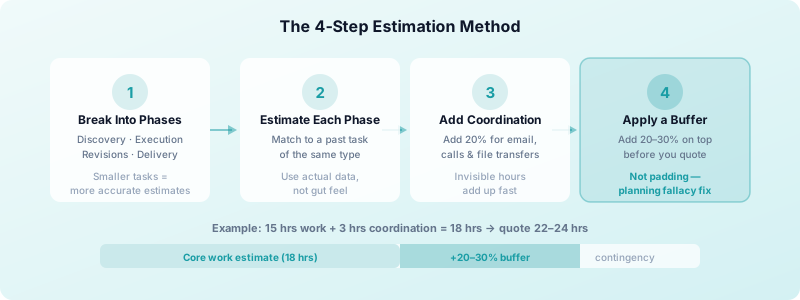
Step 1: Break the project into phases. Don't estimate the project as a whole. Estimate each phase separately — discovery, execution, revisions, delivery. Small tasks are easier to estimate accurately than large vague ones.
Step 2: Estimate each phase in hours. For each phase, think of a similar task you've done before. How long did it actually take? Use that as your baseline. If you don't have past data yet, we'll get to how to start building it.
Step 3: Add coordination time. Add 20% on top of your pure work estimate to account for emails, meetings, brief reviews, and file transfers. Client communication alone can consume two to three hours on a project you thought was fully scoped.
Step 4: Apply a buffer. Add another 20-30% to your subtotal before you quote. This is not padding — it's a realistic adjustment for the planning fallacy, scope changes, and tasks you didn't anticipate. A project estimated at 20 hours (after coordination) should be quoted as 24-26 hours.
How to Build a Personal Reference Database
The single biggest improvement you can make to your estimation accuracy is also the simplest: track your time on every project, then review it.
When you track billable hours on past projects, you build a reference library of real data. Over time, you stop guessing and start looking things up.
Here's what your reference database should capture for each completed project:
- Project type (e.g., 5-page website, brand identity, 1,000-word article)
- Estimated hours vs. actual hours
- Where time overran (revisions? discovery? a specific phase?)
- Client communication hours as a separate line item
After five or six similar projects, you'll see patterns. Maybe website projects always take 30% longer than you quote. Maybe revision rounds on logo work average 4 hours, not 2. That data is worth more than any estimation formula.
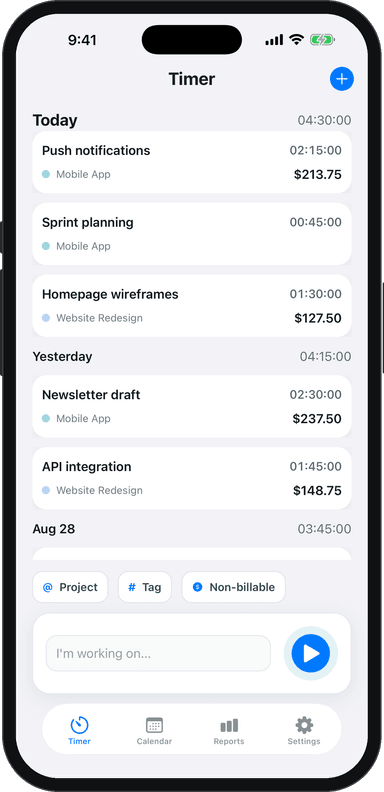
Toggle Time Tracker makes this straightforward. Log time by project and phase using one-tap timers, then review your history before quoting your next project. You'll have real numbers instead of guesses.
Adding a Buffer Without Looking Unprofessional
A lot of freelancers resist building buffers into quotes because they worry it will make them look slow or expensive. In practice, the opposite is true.
Clients don't care how many hours you estimated internally. They care about whether the project is delivered on time and on budget. When you build an honest buffer into your quote, you're more likely to deliver on both — and that builds trust.
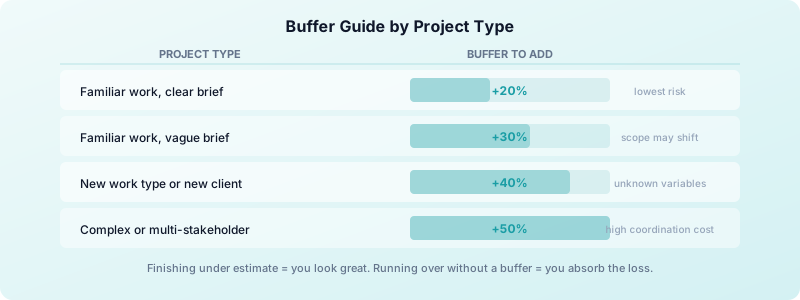
Here's a simple buffer framework:
| Project type | Suggested buffer | |---|---| | Familiar work, clear brief | +20% | | Familiar work, vague brief | +30% | | New work type or new client | +40% | | Complex or multi-stakeholder | +50% |
If you regularly finish under your estimated hours, you look like a hero. If you had quoted tight and run over, you'd be absorbing the loss or having an awkward conversation.
One more thing: if you're working on fixed-price projects, tracking your actual time is especially critical. It's the only way to know whether your flat rate is actually profitable — and to calibrate your buffers for next time.
The Only Way to Get Better at Estimating
Estimation accuracy compounds over time. The more projects you track, the better your reference database. The better your reference database, the more accurate your quotes. The more accurate your quotes, the fewer times you finish a project at a loss.
The key habit is logging time consistently — not just for billing, but for learning. Toggle Time Tracker keeps everything organized by project so your historical data is always a few taps away when you're scoping something new.
If you want to estimate freelance project time more accurately starting with your next project, the first step is to start measuring the ones you're working on right now.
Download Toggle Time Tracker and build the reference database that makes every future estimate sharper.