Freelance Productivity: The Complete Guide
Freelance productivity is not just about getting more done — it is about getting the right things done while protecting your time, income, and mental health. Without a boss setting your schedule, every productive hour is a choice you make. The freelancers who thrive long-term are the ones who build systems, not willpower.
This guide covers the full picture: scheduling, focus, time tracking, client management, and the tools that actually move the needle.
Why Freelance Productivity Is Different
Working for yourself removes the structure that most people rely on without realizing it. No fixed start time, no team to sync with, no manager to answer to. That freedom is a gift — and a trap if you are not deliberate about it.
The biggest productivity drains for freelancers are not laziness. They are unclear priorities, context switching between clients, and underestimating how much admin work eats into your day. Research shows that switching between tasks costs up to 40% of your productive time. For freelancers juggling three clients and their own business development, that cost adds up fast.
The solution is not grinding harder. It is building a framework that makes focused work the default, not the exception.
Build a Schedule That Works for Your Brain
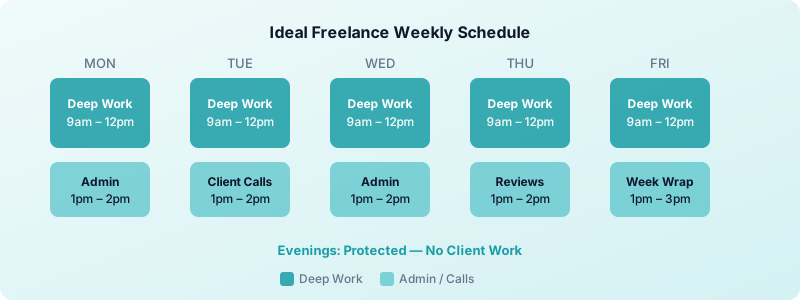
The most productive freelancers do not just fill a calendar — they design it around their energy. You have roughly three to four hours of peak cognitive capacity per day. Burn those hours on your most demanding work. Reserve email, invoicing, and admin for lower-energy windows.
A practical approach:
- Block mornings for deep work. Even if you are not a morning person, designating two to three hours at the start of your day for focused client work creates momentum.
- Group similar tasks. Answering client emails, creating invoices, and reviewing contracts are all low-focus tasks. Batch them into one administrative block instead of scattering them through the day.
- Use a weekly plan, not just a daily one. Each Sunday or Monday, map out which projects get attention on which days. This prevents the "what should I work on?" paralysis that kills productive mornings. A freelance weekly planning template makes this 30-minute habit fast and repeatable.
Consistent freelance time management is the single habit that separates freelancers who feel in control from those who feel perpetually behind.
Protect Your Focus With Boundaries and Rituals
Focus is not something you find — it is something you protect. Every notification, client message, and context switch is a request to pull your attention away from the work that pays you.
Set communication windows. Respond to emails and messages during two fixed windows — for example, 9–10 AM and 4–5 PM. Let clients know this upfront. Most will respect it, and the ones who do not are usually the ones who undervalue your time anyway.
Create a startup and shutdown ritual. Starting work the same way each day — reviewing your task list, setting a single priority, making coffee — signals your brain to shift into work mode. Ending work with a clear shutdown routine prevents the creeping anxiety of feeling like you should always be doing more. A brief end-of-day review, noting what you finished and what carries over tomorrow, is enough.
Guard your physical environment. If you work from home, your workspace sends signals. A cluttered desk, notifications visible on your phone, and a TV in the same room all compete for attention. Small changes — phone face down, inbox closed, a dedicated work area — compound over weeks into significantly more focused hours.
Track Where Your Time Actually Goes
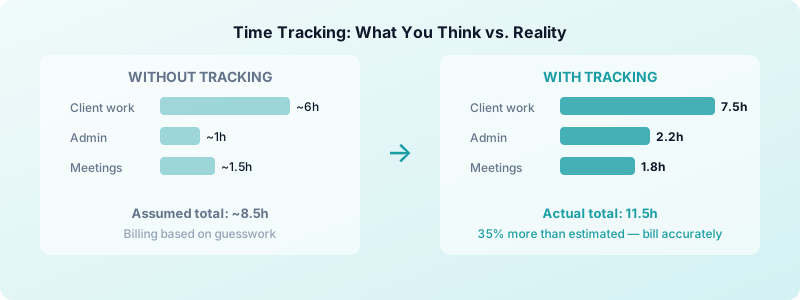
Freelancers who track their time consistently earn more — not because tracking itself makes them faster, but because the data reveals where time disappears.
Most freelancers are surprised when they first start tracking. The client project that felt like five hours actually took seven. The admin tasks that "only take a few minutes" are absorbing two hours a day. Without data, you are billing on guesswork and pricing your services on fiction.
Tracking time accurately does three things:
- It protects your income. When you know exactly how long a type of project takes, you can quote confidently and avoid the trap of absorbing cost overruns.
- It reveals your real hourly rate. If you are billing $500 for a project and it takes 10 hours, you earned $50/hr. But if it takes 15 hours and you count the admin time, your real rate may be $30/hr.
- It builds better habits. Knowing you are tracking creates a mild accountability effect — you start tasks faster and waste less time on low-value activities.
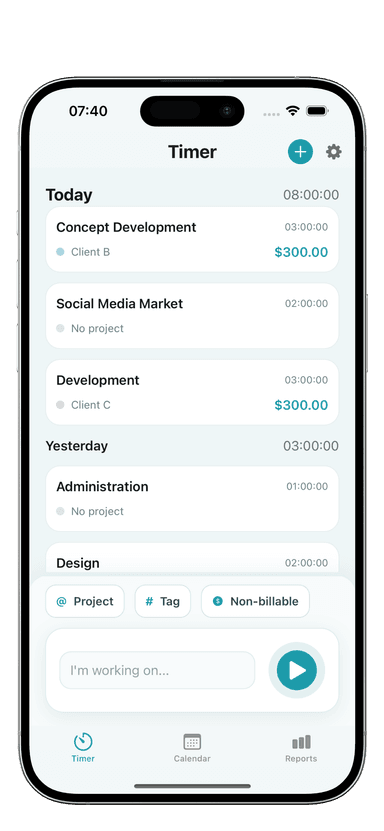
Toggle Time Tracker makes this frictionless. One tap starts a timer, entries are organized by project, and you can export a PDF or Excel report whenever a client needs documentation. No account required, and all data stays on your device.
Manage Multiple Clients Without Burning Out
Juggling several clients at once is one of the most common freelance productivity challenges. Each client has different expectations, deadlines, and communication styles. Without a system, you end up reactive — always responding to the loudest voice rather than working on what matters most.
A few principles that help:
Assign clients to days, not just to your task list. If you work on Client A on Mondays and Thursdays, and Client B on Tuesdays and Fridays, you dramatically reduce the cognitive cost of switching. Your brain loads up the context for one client and stays in it for hours, rather than toggling back and forth every thirty minutes.
Communicate proactively. Send a brief weekly update to active clients even when nothing significant has happened. This prevents the anxiety-driven check-ins that interrupt your focus. A two-sentence email every Friday takes five minutes and saves you hours of reactive communication.
Recognize the signs of overload early. The clearest early warning sign is consistently working past your planned hours without billing for it. Time tracking data makes this visible before it becomes burnout. If your tracked hours are regularly running 20% over your estimates, something needs to change — either your pricing, your scope management, or your client load.
The Productivity Stack: Tools That Actually Help
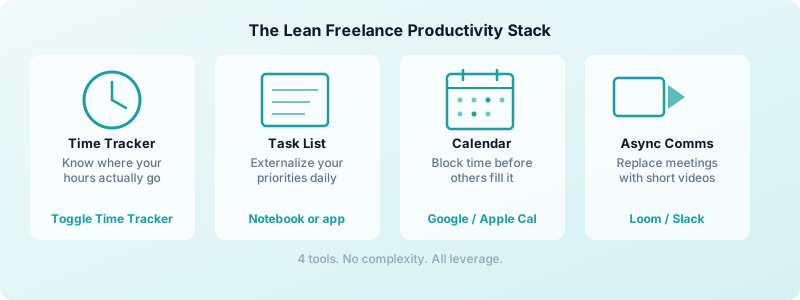
Freelance productivity tools fall into two categories: the ones that create real compounding value, and the ones that feel productive but just add complexity. Here is what actually matters:
Time tracking: The foundation. Without knowing where your time goes, every other productivity effort is guesswork. Toggle Time Tracker handles this simply — no subscriptions, no data syncing to someone else's server, no setup friction. For freelancers who want the cleanest possible tracking experience, it is the fastest way to start.
Task management: A simple system beats a complicated one. A physical notebook, a basic to-do app, or even a weekly notepad keeps your priorities visible. The key is externalizing your task list so you are not carrying it in your head.
Calendar: Block time before your week starts. Unblocked calendars fill with other people's priorities. Your own projects, deep work, and admin need to hold space on your calendar or they will always be crowded out.
Async communication: Tools like Loom let you replace a thirty-minute meeting with a three-minute video. For freelancers working across time zones or with clients who want frequent updates, async video is a significant time saver.
The goal is not to have more tools — it is to have fewer, better ones. A lean productivity toolkit that you actually use beats a sophisticated stack that sits idle.
Build the System, Not Just the Habits
The freelancers who sustain high productivity over years are not the ones with the most discipline — they are the ones who built systems that make good behavior easy and bad behavior hard. A clear schedule, a time tracking habit, proactive client communication, and a lean toolset are not separate tactics. They are one interconnected system.
Start with what is easiest to change. If you do not track your time, start there — three days of honest tracking will tell you more about your productivity than any article. If you track time but never plan your week as a freelancer, add a Sunday planning session. If you plan but still feel reactive, look at your communication habits.
Download Toggle Time Tracker and start tracking your hours today — it is the fastest way to understand where your time goes and take back control of your freelance workday.