Freelance Pricing Guide: Set Rates That Reflect Your Worth
You spent hours on a project, delivered great work, and invoiced the client — only to realize your effective hourly rate came out to $18. Sound familiar? Freelance pricing is one of the hardest skills to master, and most freelancers undercharge for years before figuring out why.
This guide breaks down everything you need to know about freelance pricing: the three core models, how to calculate a rate that actually sustains your business, and how to raise your prices without losing the clients you've worked hard to keep.
Why Most Freelancers Underprice Their Work
The most common pricing mistake is simple math: freelancers set their rate based on what they think they should earn per hour, not what they need to charge to run a sustainable business.
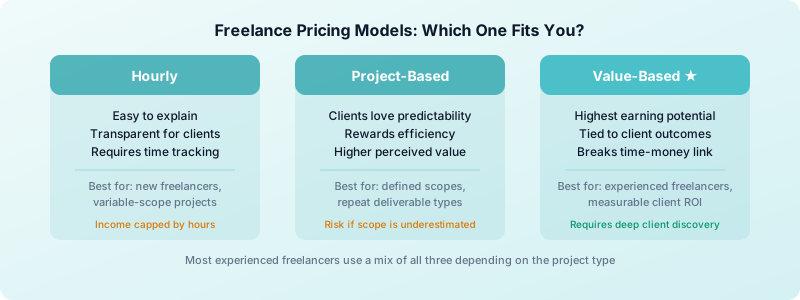
Here's what gets missed. When you work for an employer, they cover taxes, benefits, sick days, equipment, and admin time. As a freelancer, none of that is included in your rate unless you put it there yourself. Studies suggest freelancers realistically bill only 60% of their working hours — the rest goes to proposals, client emails, invoicing, and all the invisible overhead of running a solo business.
If you're charging $50/hour but only billing 25 hours of a 42-hour work week, your real rate is about $30. That gap is why so many freelancers feel underpaid even when their projects seem to be going well. Understanding what's truly billable vs. what isn't is the first step toward pricing that actually works.
The Three Main Freelance Pricing Models
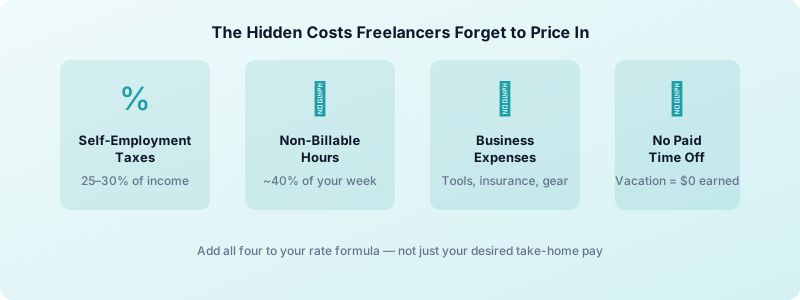
There's no single right way to price your work. The best model depends on your service type, client relationships, and how you want to structure your income.
Hourly pricing is the most common starting point for new freelancers. You agree on a rate, track your hours, and invoice for time worked. It's transparent and easy to explain, but it caps your income at your available time and penalizes you for working faster. It also requires careful time tracking — every hour unrecorded is revenue lost.
Project-based (fixed) pricing charges a flat fee for a defined deliverable. Clients love the predictability. You benefit when your efficiency improves, since you earn the same fee in fewer hours. The risk: if you underestimate scope, you absorb the loss. Accurate project estimates come from reviewing your past time data — which is why calculating your true hourly rate matters even when you don't invoice by the hour.
Value-based pricing ties your fee to the outcome you deliver, not the time you spend. A landing page that converts at 8% instead of 3% generates real revenue for your client — pricing that reflects that impact isn't just fair, it's logical. Value-based pricing is the highest-leverage model, but it requires understanding your client's business well enough to quantify your contribution. For a deep dive, see the dedicated guide on value-based pricing for freelancers.
A fourth option worth knowing is retainer pricing — a fixed monthly fee for a defined scope of ongoing work. Retainers create predictable income and deepen client relationships, making them popular with experienced freelancers who prefer stability over project variety.
How to Set Your Freelance Rates
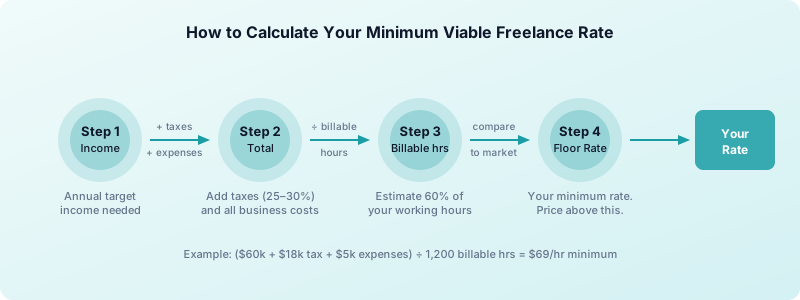
Start with your numbers, not the market. The formula:
- Calculate your annual income target — what you need to live on plus what you want to save
- Add business expenses — software, equipment, professional development, insurance
- Add a tax buffer — typically 25–30% of gross income for self-employed freelancers
- Estimate your billable hours — plan for 60% of your working hours, not 100%
- Divide the total by your billable hours — that's your minimum viable rate
If you need $60,000 net, you're paying $18,000 in taxes, spending $5,000 on business expenses, and only billing 1,200 hours per year, your minimum rate is ($60,000 + $18,000 + $5,000) ÷ 1,200 = $69/hour.
That's your floor. Market rates and experience determine how far above it you can charge.
Research what others in your specialty and region charge — platforms like Upwork, LinkedIn, and niche communities give good signal. Your rate should sit above your floor but within a range that feels defensible based on your experience and the results you deliver.
One more variable to factor in: your utilization rate can change your math significantly. A freelancer who consistently books 35 billable hours per week has more pricing flexibility than one averaging 20. The more in-demand your skills, the more you can push above your floor. Track your utilization for 60–90 days to get a realistic picture before you lock in a rate.
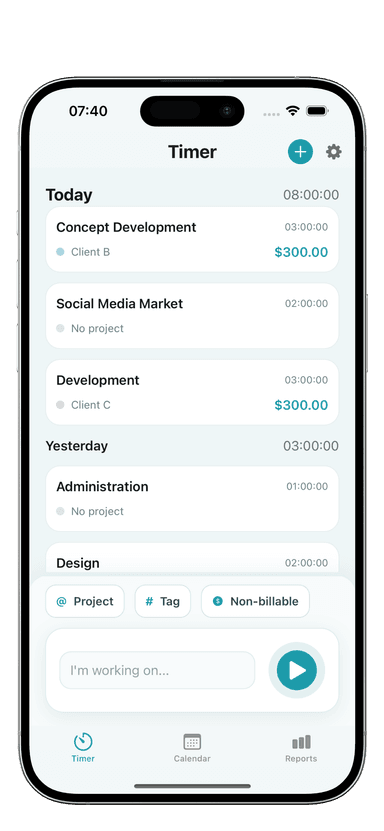
Toggle Time Tracker makes it easy to see exactly how many hours you're billing per week across projects. When you can see your actual billable ratio, you stop guessing and start pricing from real data.
How to Raise Your Freelance Rates Without Losing Clients
The most common fear around raising rates is that clients will leave. In practice, most clients who value your work will accept a reasonable increase — especially when it's communicated well and timed thoughtfully.
A good starting point: raise your rates by 10–20% per year, or whenever you've hit full capacity for 60+ days straight. Full capacity is the market telling you your price is too low.
Give notice. Tell existing clients about a rate increase 30–60 days before it takes effect. This shows respect and gives them time to adjust budgets or wrap up current work at the old rate.
Anchor to value, not cost. Instead of "my costs have increased," say "based on the results we've achieved together and my growing experience, I'm adjusting my rate to X." This frames the increase as consistent with your value, not arbitrary.
Apply new rates to new clients first. If you're not ready to raise rates across the board, start with every new client engagement. Within six months, your client mix will naturally shift toward higher-paying work.
Know your walkaway number. Some clients will push back or leave. That's not a failure — it's the market working correctly. If a client is unwilling to pay a sustainable rate, they're essentially asking you to subsidize their business. Knowing your floor rate protects you from accepting work that erodes your income over time.
Using Time Data to Price with Confidence
Every pricing decision you make gets better when it's backed by actual time data. Here's how:
- Check your effective hourly rate per project. If a fixed-fee project took longer than estimated, your effective rate dropped. That's a signal to raise the project fee or improve your scoping process next time.
- Find your slowest work categories. Some task types consistently take longer than expected. Time data reveals those patterns so you can price them more accurately — or eliminate them.
- Validate retainer pricing. Before proposing a retainer, track how long similar ongoing work actually takes. That prevents you from agreeing to a monthly scope that eats more hours than the retainer covers.
- Build a pricing database. After tracking for 3–6 months, you'll have real benchmarks: how long it takes you to write a 2,000-word article, build a landing page, or run a campaign. That's your most reliable pricing input.
- Identify your most profitable work. When you divide your fee by actual hours tracked, some projects will show a much higher effective rate than others. Focus on selling more of that work, and raise prices or improve estimates on the rest.
Toggle Time Tracker's project organization lets you group entries by client and project, so reviewing your past data takes minutes — not hours of spreadsheet hunting. When you sit down to quote a new project, you're not guessing. You're referencing your own performance history.
Price What You're Worth
Freelance pricing isn't a one-time decision. It's an ongoing calibration between what the market pays, what your business requires, and what your results justify. Most freelancers who feel underpaid haven't raised their rates in two years — and the fix isn't complex, just uncomfortable.
Start by running the numbers. Calculate your floor rate using the formula above. Compare it honestly to what you're currently charging. If there's a gap, close it — not all at once, but deliberately and consistently.
The freelancers who build sustainable businesses aren't necessarily the most talented. They're the ones who treat pricing as a skill, track their time to stay grounded in reality, and adjust their rates as their experience grows.
Download Toggle Time Tracker and start building the time data that makes every future pricing decision easier.