Freelance Late Payment: What to Do When a Client Doesn't Pay
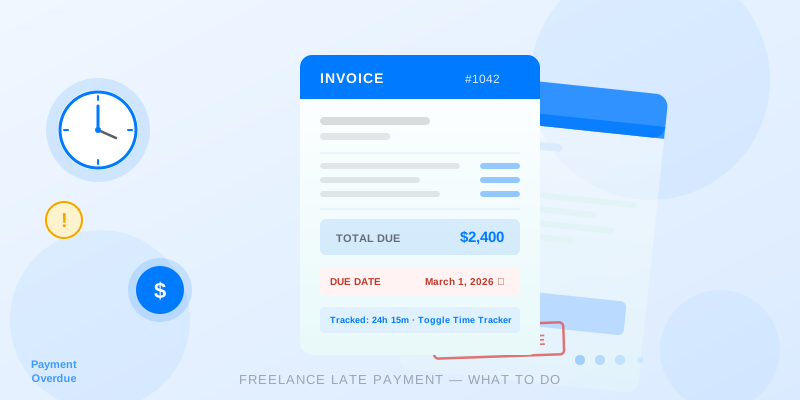
A client misses your invoice due date. Maybe it's a day, maybe it's a week. You're not sure whether to send a follow-up or wait a little longer. This is one of the most common and most stressful situations in freelancing — and most people handle it worse than they need to.
This guide walks you through exactly what to do when a client doesn't pay, step by step. From the day the payment is late to the point where you escalate to collections or small claims court.
How to Know When a Payment Is Actually Late
A payment is late the day after the due date on your invoice. Not two weeks after. Not when you feel uncomfortable bringing it up. The day after.
If your invoice said "Due March 1" and it's now March 2 with no payment in your account, the payment is late. That's your cue to act.
Before you follow up, check three things:
- Did you send the invoice to the right person? Invoices sent to a project contact sometimes never reach the billing team.
- Is there a payment processing delay? Bank transfers can take 1–3 business days. If you don't use an automated payment platform, factor that in.
- Is there a dispute you weren't told about? Sometimes clients sit on an invoice because they have a question about the work. A quick check-in often surfaces this early.
If everything looks fine on your end, it's time to follow up. No need to wait. No need to feel awkward about it.
The 4-Stage Follow-Up Process for Late Invoices
Following up on a late invoice as a freelancer is easier when you have a clear script for each stage. Here's the framework that works.
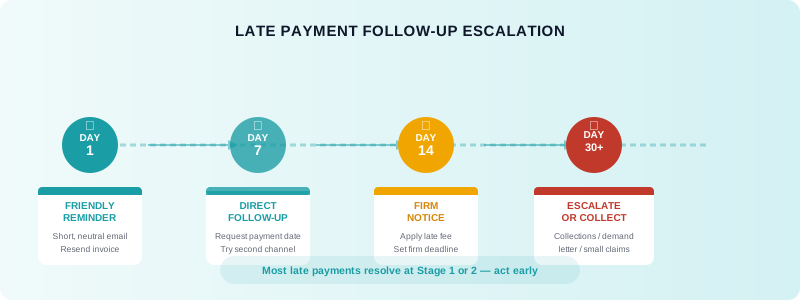
Stage 1: Day 1 Overdue — The Friendly Reminder
Send a brief, professional email. Keep the tone neutral. Most late payments at this stage are just administrative oversights.
Subject: Invoice #[number] — Payment Due Date Reminder
Hi [Name], just following up on invoice #[number] for $[amount], which was due on [date]. Please let me know if you have any questions or need me to resend it. Happy to help.
That's it. Short, professional, no pressure. Include the invoice as an attachment. Give them 48 hours to respond.
Stage 2: Day 7 Overdue — The Direct Follow-Up
If you haven't heard back or received payment after a week, escalate the tone slightly. You're still professional, but you're now asking for a specific commitment.
Subject: Following Up: Invoice #[number] Now 7 Days Overdue
Hi [Name], following up again on invoice #[number] for $[amount]. It's now 7 days past the due date. Could you confirm when I can expect payment? If there's an issue with the invoice, I'm happy to sort it out quickly.
At this stage, also try a secondary contact method. If you've only emailed so far, send a message on the platform you originally communicated through, or call if you have a number. Some clients genuinely lose emails.
Stage 3: Day 14 Overdue — The Firm Notice
Two weeks overdue is no longer an oversight. Your tone should reflect that while staying professional. If your contract or invoice included a late fee clause, this is when it kicks in.
Subject: Invoice #[number] — 14 Days Overdue, Late Fee Applied
Hi [Name], I'm writing regarding invoice #[number] for $[amount], which is now 14 days past due. Per our agreement, a late fee of $[amount] has been applied, bringing the new total to $[new amount]. I need a confirmed payment date by [specific date, 3 days out]. If I don't hear from you, I'll need to escalate this matter.
Be specific. Name the new total. Name the date you need a response by. Vague follow-ups get vague responses.
Stage 4: Day 30+ — The Final Notice Before Escalation
If the invoice is 30 or more days past due with no payment and no credible commitment, you're past the normal follow-up zone. Send a final formal notice that makes clear what happens next.
Subject: Final Notice: Invoice #[number] — 30 Days Overdue
This is a formal final notice for invoice #[number] for $[amount plus fees], originally due on [date]. If payment is not received by [specific date, 5 days out], I will proceed with formal debt collection and/or small claims court proceedings. Please treat this as urgent.
At this point, consider also contacting someone more senior at the client's company if you know how to reach them.
The first follow-up sets the tone for everything after it. The freelance payment reminder email has wording for each stage.
How to Escalate When a Client Still Doesn't Pay
Most invoices get resolved before reaching escalation. But sometimes a client goes silent, disputes a charge in bad faith, or simply refuses to pay. Here are your options.
Apply Late Fees
If you included a late fee clause in your contract or invoice terms, apply it. This gives you a small financial buffer and signals that you mean business. Late fees are typically 1.5% per month or a flat $50 per 30-day period. You need to have stated this upfront in your contract — you can't add fees retroactively that weren't agreed to.
Understanding payment terms and late fee structures before you take on a client makes these conversations far easier.
Use a Collection Agency
For invoices over $500 that you can't collect yourself, a debt collection agency is an option. They take a percentage (typically 25–50%) of whatever they recover, so it works best for larger amounts. Research freelancer-friendly options — some agencies specialize in creative industry invoices.
File in Small Claims Court
Small claims court is designed to be accessible without a lawyer. The filing fee is usually $30–$100, and you can typically claim invoices up to $10,000–$25,000 depending on your state or country.
To file, you'll need documentation:
- Your signed contract
- Copies of all invoices
- A record of all communications (emails, messages)
- Proof that work was delivered
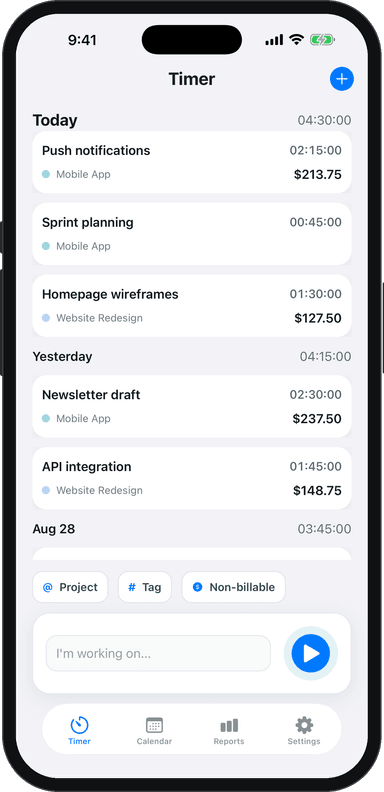
This is where your time tracking records matter. Toggle Time Tracker gives you a detailed log of every hour you worked, by project and task. That log is documentation. If a client ever claims the work wasn't done or wasn't worth what you charged, you have timestamped proof of every session.
Send a Formal Demand Letter
Before going to court, send a demand letter by certified mail. This creates a paper trail and often prompts payment before you have to file anything. You can write one yourself — it just needs to state the amount owed, the original due date, a final payment deadline, and your intention to pursue legal action if unpaid.
A late fee only works if it is in the contract before the invoice is late. A freelance late fee clause template gives you enforceable wording.
How to Prevent Late Payments Before They Happen
The best version of this problem is the one you never have to deal with. A few habits up front dramatically reduce late payments.
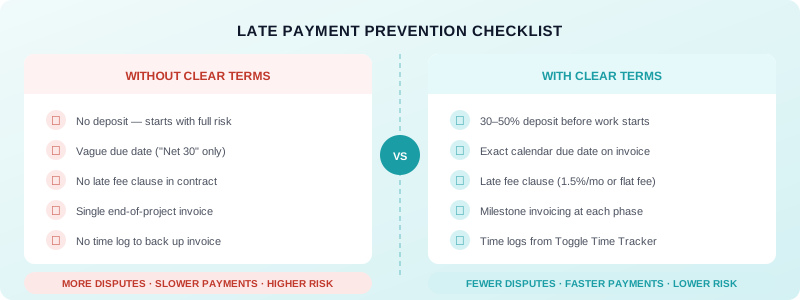
Set payment terms in your contract before work starts. Don't let the project begin without written, agreed-upon terms. This includes the payment window (Net 15 or Net 30), accepted methods, deposit requirements, and late fee clauses.
Require a deposit from new clients. A 30–50% upfront payment filters out bad-faith clients and gives you working capital before the project concludes. Most professional clients expect this. If someone refuses to pay any deposit, take that seriously.
Use milestone invoicing for larger projects. Instead of invoicing everything at the end, invoice at project phases. That way you're never completing work you haven't been paid for.
Send invoices the moment work is complete. Don't batch invoices at the end of the month or wait until you feel like dealing with it. Invoice immediately. The sooner the clock starts, the sooner you get paid.
Make your invoices crystal clear. Include the exact due date (not just "Net 30"), an itemized breakdown of work, and your payment details front and center. Clear invoicing basics reduce the friction between "invoice received" and "payment sent."
Toggle Time Tracker helps you invoice with confidence. Log your time by project as you work, and when it's time to send the invoice, you have a complete, detailed breakdown of every task and hour. Clients who see that detail are less likely to dispute or delay payment.
You Don't Have to Chase Payments Forever
Late payments are frustrating, but they're manageable with a system. Know when a payment is late, follow up at each stage without hesitation, and escalate if necessary. Most of the time, a clear and professional follow-up is all it takes.
Build the right habits before a project starts — deposit requirements, written terms, detailed invoicing — and you'll spend far less time chasing money and far more time doing work you enjoy.
Download Toggle Time Tracker and start building the time records that back up every invoice you send.