Freelance Self-Employment Tax Rate Explained
The freelance self-employment tax rate catches most new freelancers off guard. You land your first client, invoice them, and then discover you owe far more in taxes than you expected. The reason: as a freelancer, you pay both sides of Social Security and Medicare — the employee half and the employer half.
Understanding this rate before your next invoice is due can save you from a painful tax bill.
What Is Self-Employment Tax (And Why Freelancers Pay More)
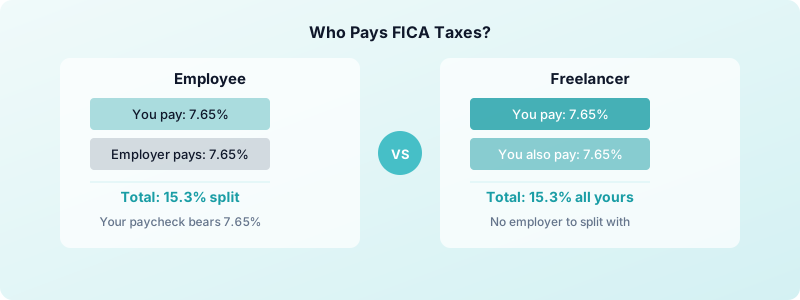
When you work a traditional job, your employer covers 7.65% of your FICA taxes — the combined Social Security and Medicare contributions. You pay the other 7.65% from your paycheck, and most people never notice it.
As a freelancer, you are both the employer and the employee. That means you pay the full 15.3% yourself.
This self-employment tax is separate from your regular income tax. You owe it on top of whatever federal and state income tax applies to your earnings. Combine the two, and it's easy to see why setting aside 25–30% of your income for taxes is the standard freelance advice.
The 15.3% Rate: Breaking Down Social Security and Medicare
The 15.3% total breaks into two components:
- Social Security: 12.4% — This applies only to the first $184,500 of net self-employment income in 2026. Income above this cap is not subject to the Social Security portion.
- Medicare: 2.9% — This applies to all net self-employment income with no cap.
If your freelance income exceeds $200,000 (single filer) or $250,000 (married filing jointly), you also owe an additional 0.9% Medicare surtax on the amount above those thresholds.
One detail that trips people up: you don't owe self-employment tax at all if your net earnings are below $400 for the year. If you're doing very small-scale freelancing, check your net income before assuming you owe it.
How to Calculate Your Self-Employment Tax Step by Step
The IRS doesn't simply apply 15.3% to your total freelance revenue. Here's the actual calculation:
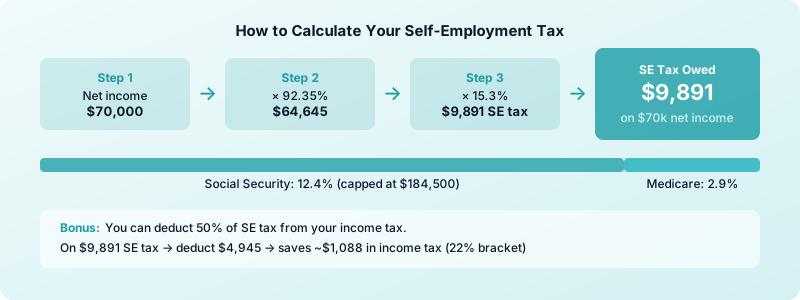
Step 1: Find your net self-employment income. Subtract business expenses from your gross freelance income. This is what you report on Schedule C. Every legitimate business expense — software, equipment, professional development, a portion of your home office — reduces this number. Tracking your freelance expenses carefully throughout the year directly lowers your SE tax.
Step 2: Multiply by 92.35%. You only pay self-employment tax on 92.35% of your net income (that's 100% minus 7.65%). The IRS gives you this adjustment to account for the employer-equivalent portion of the tax.
Step 3: Apply the 15.3% rate. Multiply the result from Step 2 by 0.153. That's your self-employment tax for the year.
Example:
- Gross freelance income: $80,000
- Business expenses: $10,000
- Net self-employment income: $70,000
- 92.35% of $70,000 = $64,645
- Self-employment tax: $64,645 × 15.3% = $9,891
That $9,891 is on top of your income tax. If your federal income tax rate is 22%, you're looking at a combined federal tax bill well over $20,000 on $80,000 of revenue. This is why knowing your freelancer tax rate before you price projects matters.
The 50% Deduction: Your Built-In Tax Break
Here's a tax break built directly into the self-employment tax calculation that many freelancers miss.
You can deduct 50% of your self-employment tax as an above-the-line deduction on your Form 1040. This reduces your adjusted gross income — and therefore your income tax — but it does not reduce the self-employment tax itself.
Using the example above: if you owe $9,891 in SE tax, you can deduct $4,945 from your gross income before calculating income tax. On a 22% tax bracket, that saves you roughly $1,088 in income tax.
It's not a huge reduction, but it's automatic. You don't need to itemize deductions to claim it.
How Much to Set Aside as a Freelancer
The safe rule: set aside 25–30% of every payment you receive into a separate savings account earmarked for taxes. This covers your self-employment tax and a reasonable estimate of federal income tax.
Why a range? Your actual income tax depends on your total income, deductions, and filing status. If you're just starting out or have significant deductions, 25% may be enough. If you're in a higher bracket or live in a high-tax state, 30% or more is safer.
The practical habit: every time a client payment hits your account, move 28% (a useful midpoint) to your tax savings account immediately. Don't wait until the end of the quarter.
Quarterly estimated tax payments are required if you expect to owe $1,000 or more in taxes for the year. The due dates are April 15, June 15, September 15, and January 15. Missing these payments results in underpayment penalties, which are avoidable with consistent saving habits.
Toggle Time Tracker makes this easier because you always know exactly how much you've earned each month. Open your reports, see your income, apply 28%, and transfer. No guessing.
Strategies to Reduce Your Self-Employment Tax Bill
Self-employment tax is unavoidable, but you can legitimately reduce the base it applies to:
Maximize business deductions. Every dollar of legitimate business expense reduces your net self-employment income — and therefore the amount SE tax is calculated on. The most commonly missed freelance tax deductions include: home office (dedicated workspace in your home), health insurance premiums (100% deductible for self-employed), professional development, and business software subscriptions.
Contribute to a retirement account. SEP IRA and Solo 401(k) contributions reduce your adjusted gross income but do not reduce self-employment tax. They do, however, lower your income tax, which is still meaningful. Our guide to freelance SEP IRA retirement savings explains how to calculate your contribution and set up an account before your tax deadline.
Consider your business structure as you grow. Once your net self-employment income consistently exceeds roughly $50,000–$60,000 per year, an S corporation structure can reduce SE tax by splitting income between a reasonable salary and distributions. The distributions are not subject to self-employment tax. This strategy involves setup costs and more administrative work — consult a tax professional before pursuing it.
Track time to improve profitability. This is indirect but effective. Freelancers who track time accurately tend to spot underpriced projects, bill more completely, and make data-driven pricing decisions. Higher effective rates mean you can earn the same income with fewer hours — and since SE tax is based on net income, maximizing your effective rate gives you more after-tax dollars.
Download Toggle Time Tracker and start tracking every hour you work. When you know exactly how much time each project takes, you can price future work confidently — and keep more of what you earn.
Note: Tax rates, thresholds, and deduction rules change annually. The figures in this article reflect 2026 tax year information. Consult a qualified tax professional for advice specific to your situation.