How to Stop Working Overtime as a Freelancer
Working long hours feels like dedication — until it becomes the default. If you are regularly finishing projects at 11pm, squeezing in "quick tasks" on weekends, or can't remember the last evening you truly switched off, you are not working hard: you are working overtime. Learning how to stop working overtime as a freelancer is less about willpower and more about fixing the systems that let overtime creep in the first place.
Why Overtime Becomes a Habit for Freelancers
Overtime is not random. It follows predictable patterns that most freelancers share.
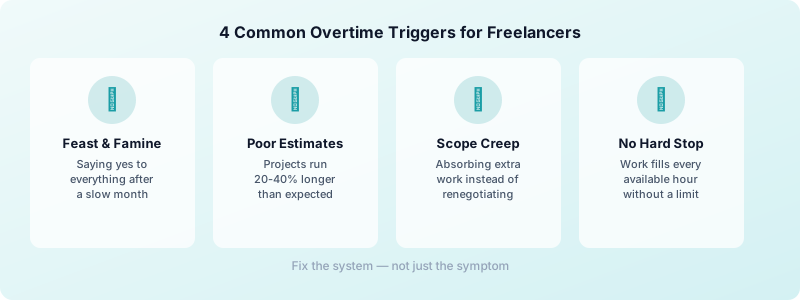
The feast-or-famine reflex. After a slow month, the instinct is to say yes to everything when work floods back. You load up your schedule to make up for lost income — and suddenly you are working 55 hours to cover 40 hours of capacity.
Underestimated projects. Most freelancers underestimate task duration by 20-40%. When a "three-hour" project takes five, those two extra hours have to come from somewhere. They come from your evenings.
Scope creep without a response. A client adds one small revision. Then another. Then a new deliverable. Without a clear process for handling scope changes, you absorb the extra work rather than renegotiate. This compounds across every active project.
No defined end to the workday. Employees have office closing times. Freelancers often do not. Without a structural stopping point, work fills whatever time is available — and there is always more time available.
Set a Hard Limit on Your Weekly Hours
The most effective way to stop working overtime is to decide — in advance — exactly how many hours you will work per week, and treat that number like a client deadline.
Start with your actual recent average. Pull your last four weeks of logged hours and calculate the mean. That is your baseline. Now set your ceiling 10-15% lower than that average. Most freelancers discover they can hit the same output with fewer, more focused hours once they have a real constraint.
A typical sustainable target looks something like this:
- Billable hours: 25-30 hours per week
- Admin, emails, invoicing: 5-7 hours per week
- Total: 30-37 hours per week
Once you have the number, block your working hours in your calendar. Anything outside those blocks is off the table. The boundary only works if you enforce it — not occasionally, but consistently.
Tackle the Root Causes, Not Just the Symptoms
Working fewer hours is the goal. But if you only enforce a hard stop without fixing what is driving the overtime, you will just end each day with a pile of unfinished work and rising anxiety. Address the causes directly.
If the problem is too many clients: Audit your current workload against your hourly capacity. If you are fully booked at your target rate but still overworking, your rates are too low or your project minimums are set incorrectly. Raising rates is often the fastest path to working fewer hours for the same income.
If the problem is scope creep: Write a one-paragraph scope policy and include it in every new contract. Any work beyond the agreed scope is billed separately at your hourly rate. Make this clear upfront, not after the fact.
If the problem is poor estimates: Track the actual time every project takes, not just the billable portion. Compare your estimates to actuals monthly. After 60 days of honest data, your estimates will improve significantly — and the overtime caused by underestimation will shrink.
If the problem is context switching: Grouping similar tasks into blocks — all client emails in one session, all deep work in another — can recover 2-3 hours per week that would otherwise be lost to switching costs. That alone can pull your total hours below the overtime threshold.
Use Your Time Data to Enforce the Boundary
The hardest part of stopping overtime is not setting the rule. It is catching yourself in real time before you have already gone two hours over.
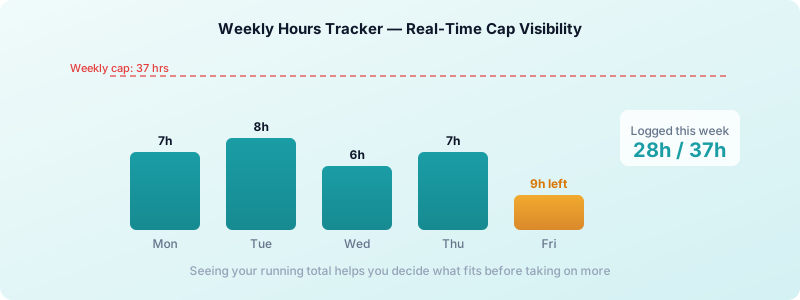
Consistent time tracking gives you an early warning system. When you can see your running weekly total at a glance — say, 28 hours logged by Thursday — you know exactly how much capacity is left before you hit your limit. That visibility changes your decisions. Instead of reflexively starting a new task Friday afternoon, you assess whether it fits in the remaining time or gets rescheduled.
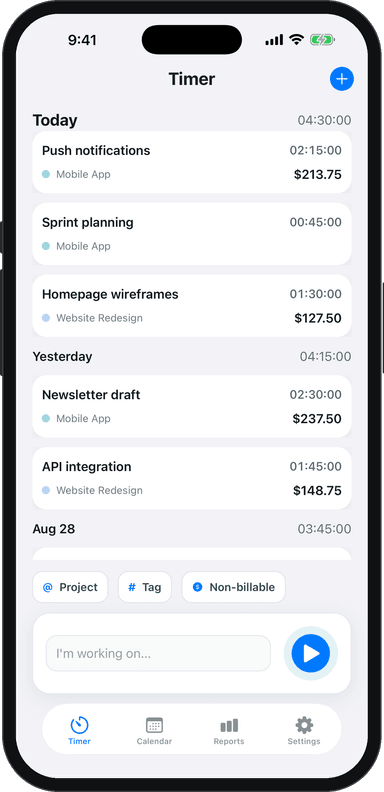
Toggle Time Tracker makes this real-time visibility practical. Log each work session with a single tap, organized by project. Your weekly report shows exactly where your hours went — which clients consumed the most time, what your billable ratio looks like, and whether your total is creeping toward your cap. Because the app stores data locally on your device and works offline, there is no friction in logging a short session or checking your weekly total mid-day.
Practical Changes That Make a Real Difference
Beyond systems and data, several specific habit changes have an outsized impact on freelance overtime.
Create a shutdown ritual. A brief end-of-day routine — reviewing tomorrow's priorities, closing all tabs, writing a three-line wrap-up — signals to your brain that work is done. Without this signal, work mentally continues long after the laptop closes. Research shows that this kind of deliberate closure reduces the background task-rumination that keeps many freelancers mentally "at work" during evenings.
Stop treating small overruns as acceptable. Twenty extra minutes today, thirty tomorrow, an hour on Thursday — that is overtime, even if no single day feels bad. The freelancers who are best at stopping overtime as a freelancer catch these micro-overruns early rather than letting them normalize.
Protect one full day per week. Not a "light day." A full day off with no checking of messages, no quick tasks, no catching up. Recovery requires real rest. If one full day off feels impossible, that is a signal about how much the system needs fixing — not just how dedicated you are.
Revisit your availability policy. If clients can reach you evenings and weekends and expect a response, you have implicitly agreed to be available then. Update your email signature and project onboarding materials to set clear response hours. Most clients adapt without friction.
Recognizing the warning signs of overwork early gives you options. The freelance time management tips that actually stick are the ones backed by data — not just intention. And if you are already feeling the effects, addressing freelance burnout before it becomes severe is far easier than recovering from it.
Download Toggle Time Tracker and set your weekly hour cap today. Your time log will show you the truth about where overtime is coming from — and give you the data to do something about it.