How to Say No to Clients as a Freelancer (Without Burning Bridges)
Every freelancer learns this lesson eventually: saying yes to everything is what kills your business. The more you chase every project, every low-ball offer, and every vague request, the faster you burn out and the slower you grow. Learning to say no to clients is not a luxury — it is a core business skill.
The good news? You can decline work professionally, keep the relationship intact, and often come out looking more credible for it.
Why Saying Yes to Everything Is Actually Bad for Business
When you accept work that does not fit, you pay for it in ways that do not show up on an invoice. You miss deadlines on projects you care about. Your best clients get your worst focus. You undercharge because you are too stretched to push back on rates.
Overcommitting also creates a reputation problem. Clients talk to each other. Delivering mediocre work on a bad-fit project does more damage than politely declining it ever would.
Saying no strategically is how you make room for the right work — projects that pay well, fit your skills, and come from clients who respect your time. That is not turning down revenue. That is protecting your work-life balance as a deliberate business strategy.
Situations When You Should Say No
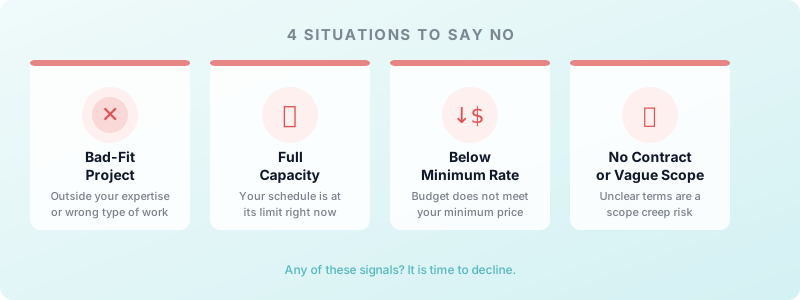
Not every "no" is the same. Here are the four clearest signals that declining is the right move.
You are at full capacity. If taking this project means staying up late, rushing other work, or delivering below your standard, it is not worth it. Saying yes when you are stretched is a promise you cannot keep.
The rate is below your minimum. Some clients will push back on your pricing. If meeting their budget means undervaluing your work, that relationship will breed resentment. Hold your rate or walk away.
The project is a bad fit. If the scope is outside your expertise or the client's expectations are unrealistic from the first conversation, the final result will disappoint both of you.
There is no contract or the terms are unclear. Vague agreements lead to scope creep. If a client refuses to commit to clear deliverables and payment terms, that is a red flag worth heeding before you start.
How to Say No Professionally (Scripts and Templates)
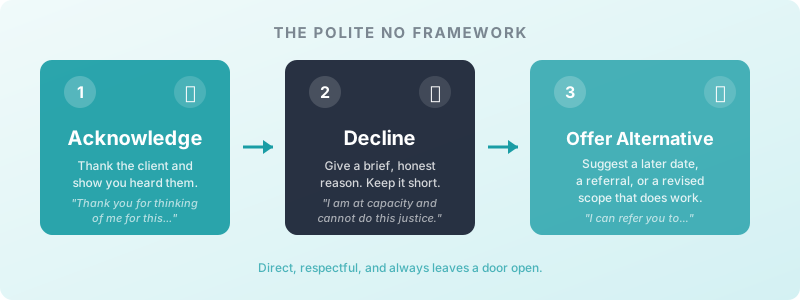
The structure that works best is simple: acknowledge, decline, offer an alternative. You respect their request, give a brief reason, and leave them with a path forward.
When you are fully booked:
"Thank you for thinking of me — this sounds like a great project. I am at capacity right now and cannot give it the attention it deserves. I would be happy to revisit in [timeframe], or I can point you toward a colleague who might be a good fit."
When the rate does not work:
"I appreciate you reaching out. Based on the scope you have described, my rate for this would be [your rate]. If that does not fit your budget, I understand — it may not be the right match at this stage."
When the project is outside your zone:
"This is not an area where I do my best work, and I would not want to do the project a disservice. I can refer you to someone who specialises in exactly this."
These scripts work because they are direct without being cold. You are not making excuses — you are being honest about fit. That honesty builds trust even when the answer is no.
How to Say No to a Current Client Without Damaging the Relationship
Turning down a new enquiry is easier than declining a request from someone you already work with. But existing clients will sometimes ask for things outside your scope, at the wrong time, or at a rate you cannot accept.
Start by acknowledging the relationship and the request. Do not make it feel like a rejection of them personally — frame it as a matter of capacity or fit.
Try: "I want to do this well for you, and right now I cannot commit to it without affecting the quality of [current work]. Can we look at a later date, or would it make sense to bring in someone else for this piece?"
This approach keeps setting clear boundaries with clients from feeling adversarial. You are not saying no to the client — you are saying no to a specific request at a specific time. That distinction matters.
If the client pushes back, hold your position calmly. Giving in because of pressure — not because anything has actually changed — sets a precedent you will regret.
Use Your Time Data to Justify Your No
The hardest part of saying no is the internal doubt. What if you are just being lazy? What if you actually have the bandwidth?
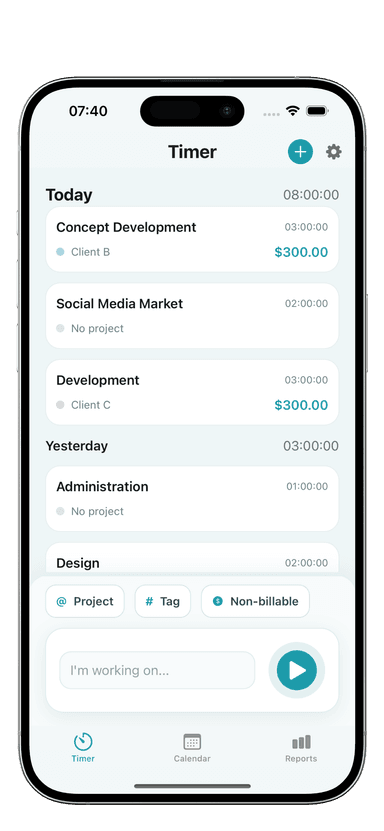
This is where tracking your hours pays off beyond invoicing. When you log your time consistently in Toggle Time Tracker, you can see exactly how full your week is. You stop second-guessing yourself because the data answers the question for you.
Before you respond to a new enquiry, check your hours. If your billable time is already at your target, you have a concrete, honest reason to decline — not a gut feeling, but a fact. That makes the conversation easier and makes you look professional, not avoidant.
Time data also helps with existing clients. If a client asks for additional work and you can show that you are already at capacity on their current project, that is a far more compelling conversation than simply saying you are busy.
Saying no is a skill you get better at with practice. Start with the scripts above, keep your declines brief and warm, and always offer a next step when you can. The freelancers who build sustainable businesses are not the ones who never turn down work — they are the ones who know which work to take.
Ready to take control of your time and stop guessing at your capacity? Download Toggle Time Tracker and start logging your hours today.