Freelance Payment Reminder Email: What to Say (+ Templates)
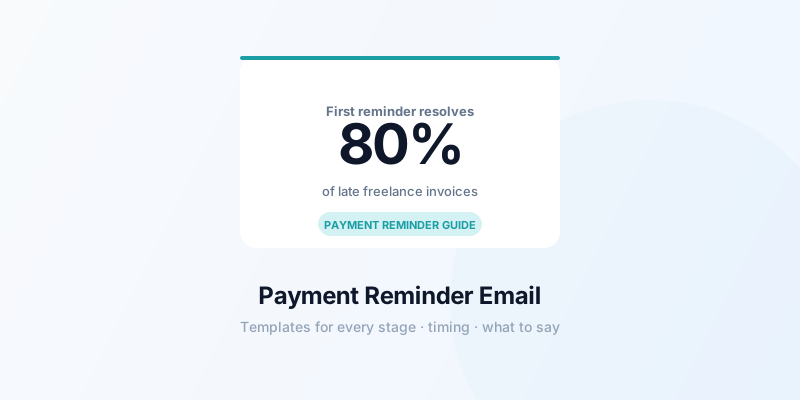
Sending a freelance payment reminder email is one of the most uncomfortable tasks in freelancing — but avoiding it is what costs you money. Most late invoices aren't due to bad-faith clients; they're due to busy people who forgot or an invoice that got lost in an email thread. A well-crafted reminder fixes 80% of late payments without any drama.
Here are templates and timing guidance for every stage of the payment reminder process.
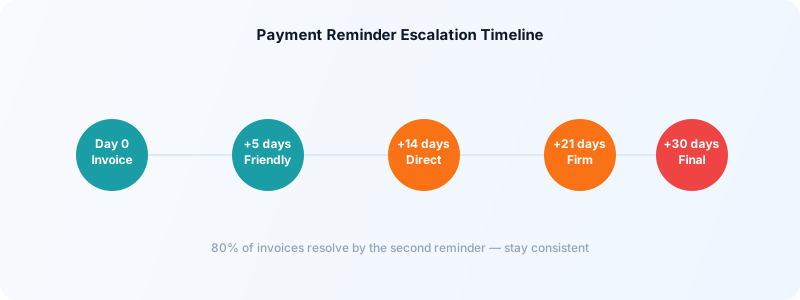
The Timeline: When to Send Each Reminder
Timing matters as much as content. You want to be proactive without being aggressive.
Before the due date (optional — 3 days before): Only for clients with a history of paying late, or very large invoices. A gentle check-in that confirms they received the invoice.
On the due date (no reminder needed): Your invoice already stated the due date. Don't email on the day it's due unless it's a specific situation.
3-5 days after due date: First reminder. Friendly, brief, assumes an oversight.
10-14 days after due date: Second reminder. More direct, includes all invoice details, offers to resend.
21-30 days after due date: Third and firm reminder. Clear about the overdue status, mentions late fees if applicable.
30+ days: Final notice before escalation. States consequences (collections, late fees, pausing work).
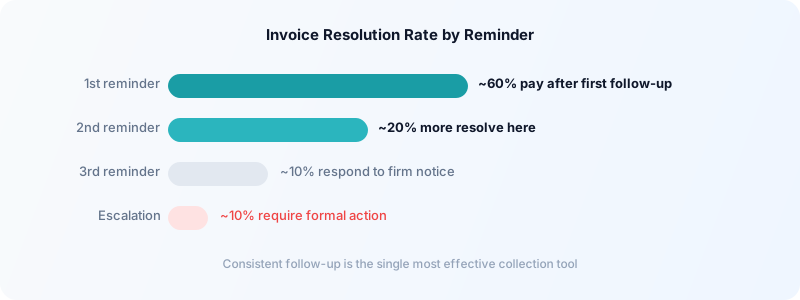
Most invoices are resolved in the first or second reminder. Only a small fraction require a third.
Template 1: Friendly First Reminder (3-5 Days Overdue)
Subject: Invoice #INV-2026-04-001 — Quick Follow-Up
Hi [Name],
Just following up on invoice #INV-2026-04-001 for $1,800, which was due on April 15. I wanted to make sure it didn't get lost in the shuffle.
Please let me know if you have any questions or need me to resend the invoice.
Thanks, [Your name]
This is short, assumes good faith, and makes it easy for them to respond. No accusatory language, no mention of consequences. Most clients pay within 48 hours of this email.
Template 2: Second Reminder (10-14 Days Overdue)
Subject: Invoice #INV-2026-04-001 — Now 10 Days Overdue
Hi [Name],
Invoice #INV-2026-04-001 for $1,800 is now 10 days past its due date of April 15. I'm following up to check on the status.
Invoice details:
- Invoice number: INV-2026-04-001
- Amount due: $1,800
- Due date: April 15, 2026
- Payment methods: [Bank transfer details / PayPal link]
Please let me know the expected payment date, or if there's anything preventing payment that I can help resolve.
Best, [Your name]
More specific, includes all the information they need to pay immediately. Asking for the "expected payment date" creates gentle accountability without conflict.
Template 3: Firm Third Reminder (21-30 Days Overdue)
Subject: Invoice #INV-2026-04-001 — 3 Weeks Overdue, Requires Immediate Attention
Hi [Name],
Invoice #INV-2026-04-001 for $1,800 is now 21 days overdue. I need to resolve this before I can continue any additional work.
Per our agreement, a late fee of 1.5% per month applies to overdue balances. I'd prefer to resolve this without applying late charges — please arrange payment by [specific date 5 days out].
If you're experiencing a delay, please contact me directly so we can discuss options.
[Invoice attached]
[Your name]
This version:
- States the actual number of days overdue
- Mentions late fees (if you have them in your terms)
- Sets a specific deadline
- Opens a door for honest conversation about delays
Template 4: Final Notice (30+ Days)
Subject: Final Notice: Invoice #INV-2026-04-001 — Action Required by [Date]
Hi [Name],
This is a final notice regarding invoice #INV-2026-04-001 for $1,800, now 30 days overdue.
If payment is not received by [specific date], I will need to:
- Apply the accumulated late fees ($[amount])
- Pause any ongoing work
- Pursue formal collection if necessary
Please arrange payment immediately or contact me to discuss the situation.
[Your name]
This is firm but still professional. The goal is resolution, not a legal battle. Most clients respond to this — either they pay, or they explain a genuine issue that you can work through together.
Tips for All Reminder Emails
Keep them short. Long emails get skimmed or ignored. Short, specific, and easy to act on gets better results.
Include all invoice details every time. Don't make the client search for the original invoice. Include the invoice number, amount, due date, and payment information in every follow-up.
Don't apologize for following up. You're not asking for a favor — you're asking for payment you've already earned.
Attach the invoice. Always. Even if you've attached it before.
Send from your professional email. Not a personal Gmail with a nickname — from your business email.
For clients who consistently need reminders, the fix is to address it at the contract stage rather than chasing payment every time. See how to get freelance clients to pay on time for systemic solutions.
What Happens When Reminders Don't Work
If you've sent three reminders and still haven't received payment, your options escalate:
- Final written notice with a specific deadline and stated consequence
- Phone call — direct conversation often resolves things that emails can't
- Late fee application — apply the fees stated in your contract
- Pause work — don't deliver more until the overdue invoice is resolved
- Collections or small claims — for persistent non-payers on significant amounts
For the full escalation process, see what to do when a freelance invoice is overdue.
Time Tracking as Invoice Documentation
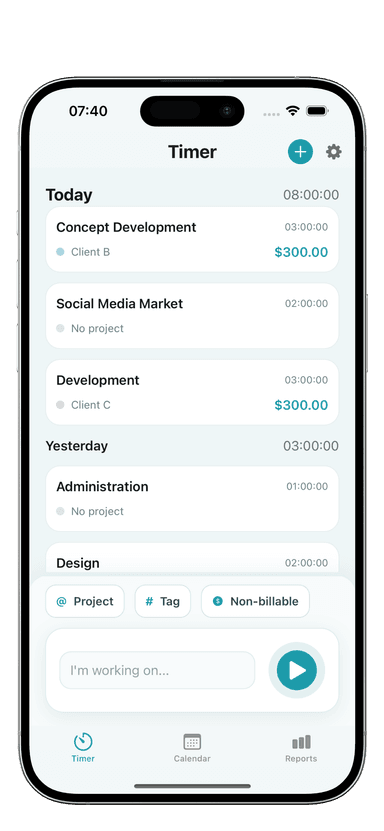
When clients push back on payment, the clearest defense is a detailed time log attached to your invoice. Toggle Time Tracker lets you build this automatically — every hour logged, tagged to a project, and exportable as a professional report.
An invoice backed by a 20-line time log is extremely difficult to dispute. It removes the ambiguity about what was delivered, making both initial payment and reminder conversations much smoother.
Download Toggle Time Tracker and start attaching time logs to every invoice — it's the single best way to reduce the need for payment reminders in the first place.