Focus Sprints vs Long Work Sessions for Freelancers
Should you work in short, intense bursts or settle in for a long uninterrupted stretch? The debate between freelance focus sprints vs long work sessions is not as simple as "one method wins." The right answer depends on the task, your energy, and what you are actually trying to produce.
Understanding both approaches — and when to use each — is one of the most impactful decisions you can make about how you structure your day.
What Are Focus Sprints (and Why They Work)
A focus sprint is a short, time-boxed block of concentrated work — typically 25 to 90 minutes — followed by a deliberate break. The most well-known framework is the Pomodoro technique for freelancers: 25 minutes of work, 5-minute break, repeat.
The appeal is grounded in how your brain actually functions. Your body runs on ultradian rhythms — 90 to 120 minute cycles that alternate between higher and lower alertness. Sprints work with these cycles rather than against them.
A few specific benefits:
- Parkinson's Law works in your favor. Give yourself 30 minutes to draft an email and it takes 30 minutes. Give yourself two hours and it mysteriously expands. Sprints impose a deadline that keeps work tight.
- Lower activation energy. It is much easier to commit to a 25-minute block than to sit down "for the morning." Starting becomes less of a battle.
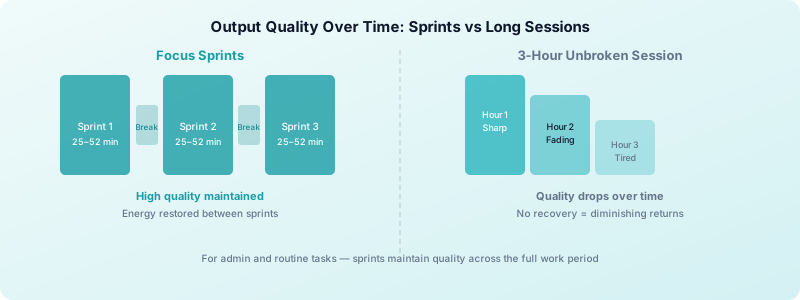
- Built-in recovery. Short breaks between sprints prevent the mental fatigue that makes the back half of a long session unproductive.
Research suggests the most productive workers tend to work intensely for roughly 52 minutes and then take a 17-minute break. The exact numbers vary, but the pattern is consistent: intensity followed by recovery beats grinding for hours with no relief.
The Case for Long Work Sessions
Long sessions — 2 to 4 hours of uninterrupted deep work — have their own advantages, and for certain types of freelance work, they are simply more effective.
The reason: flow state. When you are deeply immersed in a complex problem, the first 30 to 45 minutes is often just warm-up. You are loading context, finding your footing, orienting yourself to what you were doing. If you cut the session off at 25 minutes and take a break, you lose that buildup and have to start over.
For deep work techniques for extended focus, uninterrupted long sessions are often necessary:
- Writing a long-form article or report
- Working through a complex design problem
- Writing or debugging a substantial piece of code
- Doing serious research or analysis
The cost of interruption for these tasks is high. A short sprint followed by a break does not give your brain the continuity it needs to do its best work on cognitively demanding projects.
Which Tasks Suit Sprints vs Long Sessions
The most practical framework is to match your session structure to the type of work:
Short sprints work best for:
- Email and client communication
- Administrative tasks (invoicing, expense tracking, scheduling)
- Social media and content creation in short formats
- Repetitive tasks with clear completion criteria
- Any task you have been avoiding (a sprint makes starting feel manageable)
Long sessions work best for:
- Writing, editing, or revising substantial documents
- Complex creative projects (design, video, illustration)
- Programming or technical problem-solving
- Strategic planning or deep research
- Learning new skills or mastering new tools
The key insight: most freelancers have both types of work in their day. The mistake is applying the same session structure to everything — using sprints for deep creative work (cutting off flow state) or grinding in a 3-hour block on email (diminishing returns after the first 30 minutes).
How to Find Your Optimal Session Length
Your ideal session length is personal. Here is a practical way to figure it out:
Track your actual output, not just your time. For one week, log every work session in Toggle Time Tracker with a clear note about what you were working on. At the end of the week, review which sessions produced the best output relative to their length. You will likely see a pattern — and it may surprise you.
Pay attention to where your energy peaks. Most freelancers do their sharpest cognitive work in a specific window — often the first two to three hours after waking. Use your peak energy window for your longest, hardest sessions. When energy dips, shift to shorter sprint-based work.
Experiment with session lengths deliberately. For two weeks, try doing all your writing and creative work in 90-minute blocks. The following two weeks, try 25-minute sprints. Compare what you actually produced. The data will guide you better than any productivity framework.
Building a Hybrid Schedule That Fits Your Work
The most effective freelancers do not pick one approach — they use both strategically as part of their freelance time management strategy.
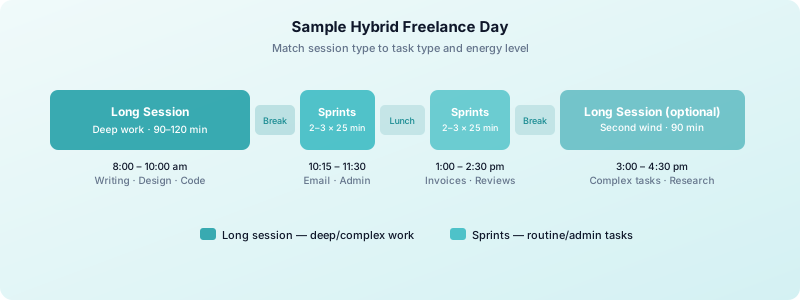
A practical hybrid structure:
- Morning (peak energy): One long 90-minute to 2-hour session for your most demanding creative or technical work
- Mid-morning: 2 to 3 short sprints for client communication, quick deliverables, or tasks that have been lingering
- After lunch (energy dip): Light administrative work in sprint format — invoicing, scheduling, responding to non-urgent messages
- Late afternoon (second wind): A second long session if you have it, or wrap up with shorter tasks
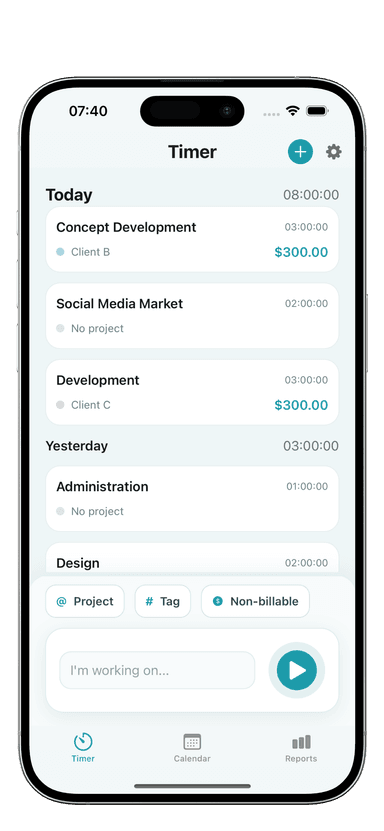
The shift from one format to the other does not have to be complicated. Toggle Time Tracker makes it easy to mark sessions by type — name a session "deep work: article draft" or "sprint: client emails" — so you can see at a glance how your day was actually structured versus how you intended it to be.
Over a few weeks of tracking, you will build a clear picture of which session types you are under-using and where your energy is going.
The Bottom Line
The debate between freelance focus sprints vs long work sessions does not have a universal winner. Both are effective — for the right kind of work.
Use short, time-boxed sprints for administrative tasks, email, and anything with a clear, bounded scope. Use longer, uninterrupted sessions for deep creative and technical work that rewards immersion.
The most important step is to stop treating all work as the same and start matching your session structure to the task in front of you. Track your sessions, review your output, and adjust. Within a few weeks, you will have a schedule built around how you actually think — not how a productivity framework tells you to.
Download Toggle Time Tracker and start tracking your focus sessions by type this week. You might be surprised what the data shows about where your best work is actually happening.