Freelance Net 60: Is It Worth Accepting?
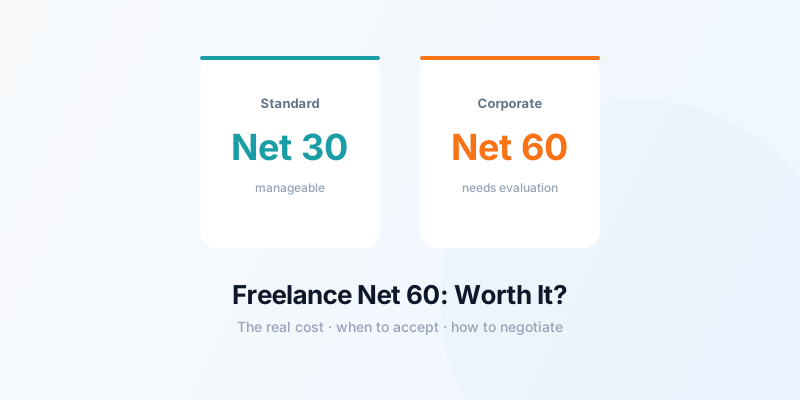
Net 60 payment terms mean you won't get paid for 60 days after sending an invoice. For most freelancers, that's an extremely long time to wait for money you've already earned. But large corporate clients routinely impose Net 60 — or even longer — as their standard payment policy. So is freelance Net 60 worth accepting, or should you push back?
The honest answer: it depends on the client, the rate, and your cash flow situation. Here's how to think through it.
What Net 60 Actually Costs You
On the surface, Net 60 just means you wait two months. In practice, it has real costs that are easy to underestimate:
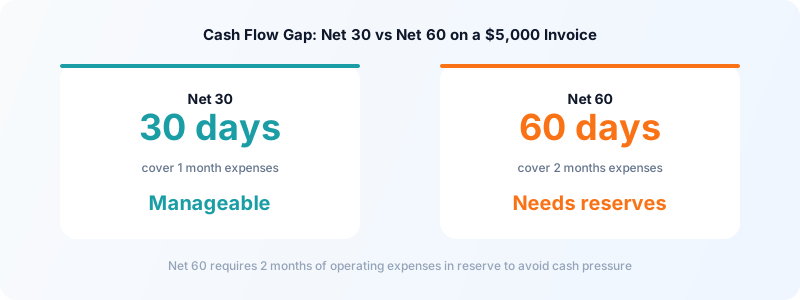
Cash flow gap. If you complete $5,000 worth of work in January, you won't receive payment until late March. Meanwhile, you have February and March expenses — software, taxes, living costs — that need to be covered.
Inflation and opportunity cost. Money received in 60 days is worth slightly less than money received today. At even modest inflation, the real value of that payment declines while you wait.
Increased non-payment risk. The longer the period between invoice and payment, the more things can go wrong — budget cuts, company instability, personnel changes in the AP department. Net 60 invoices have statistically higher non-payment rates than Net 15 invoices.
Cash flow forecasting complexity. If you have multiple Net 60 clients, projecting your actual available income becomes significantly harder. You may show high billable revenue while having very little cash on hand.
When Net 60 Is Worth Accepting
That said, there are legitimate reasons to accept Net 60:
The rate compensates for the wait. If a client offers $200/hr with Net 60, and comparable work pays $120/hr with Net 15, the premium offsets the delay. Run the math: is the extra income worth the cash flow strain?
The client is a large, stable company with predictable AP. A Fortune 500 company with Net 60 terms will almost certainly pay. The risk of non-payment is near zero. In this case, Net 60 is an inconvenience, not a real risk.
You have strong cash reserves. With 3-6 months of expenses saved, a 60-day wait doesn't create financial pressure. You're choosing to accept the terms from a position of strength, not desperation.
The relationship has long-term value. Breaking into a major client relationship sometimes requires accepting their standard terms initially. Once the relationship is established, you have more leverage to negotiate.
When to Push Back on Net 60
You should negotiate against Net 60 in these situations:
You're a solo freelancer, not a staffed agency. Large companies impose Net 60 on vendors partly because their AP systems are designed for companies with treasury departments and credit lines. You don't have those. Politely explaining this sometimes moves the terms.
It creates a genuine financial hardship. If you'd have to take on debt or draw from savings to cover basic expenses while waiting, that's a real cost. Factor it into your rate — or push for better terms.
The invoice is for a significant portion of your monthly revenue. If one client represents 40% of your monthly billings, a Net 60 from them creates a cash flow cliff every two months.
How to Negotiate Better Terms
Most clients don't negotiate payment terms by default — they just apply their standard policy. But many will consider requests if presented professionally:
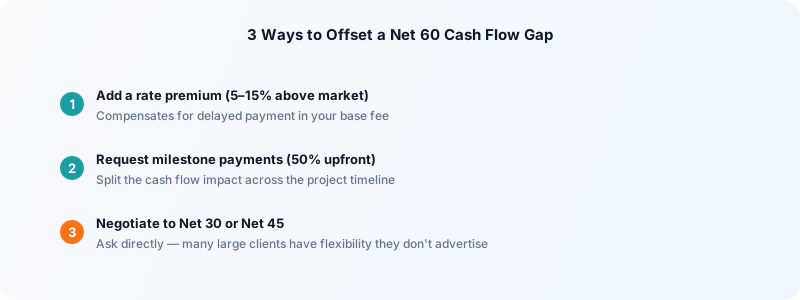
Option 1: Request Net 30 instead. Simply ask: "My standard payment terms are Net 30. Is there flexibility to use that for our invoices?" Often, especially with smaller engagements, this is approved without friction.
Option 2: Request milestone payments. Instead of one invoice at project completion, propose 50% at kickoff and 50% on delivery. This splits the risk and keeps cash flowing during the project.
Option 3: Add a premium for extended terms. "My standard rate is $X with Net 30 terms. With Net 60, I'd need to add 5% to the project rate to offset the cash flow impact." This is entirely legitimate and frames it as a business decision, not a dispute.
For more on payment terms negotiation, see how to negotiate freelance payment terms.
Track Time Meticulously With Long-Term Clients
When you accept Net 60 from a client, your time tracking becomes even more important. A time log that's clear, detailed, and exportable gives you the strongest possible invoice — which large AP departments process faster and dispute less.
Toggle Time Tracker lets you log every hour by project, export a formatted time report, and attach it to any invoice. When your invoice arrives with a clear 20-line time log showing exactly what you delivered, it moves through approval faster — even at Net 60.
The Net 60 Decision Framework
Before accepting Net 60, answer these four questions:
- Is the rate 15-20% above market? If yes, the premium may offset the delay.
- Do you have 2+ months of cash reserves? If yes, the wait doesn't create hardship.
- Is this a stable company with reliable AP? If yes, non-payment risk is low.
- Is this a significant long-term opportunity? If yes, accepting terms to get in the door may be worth it.
If you answer yes to 3 or 4 of these, Net 60 is likely worth accepting. If you answer yes to fewer, push back or build the cost into your rate.
You don't need to accept any client's terms as non-negotiable. Your payment terms are part of the project agreement — and you're allowed to have a business opinion about them.
Download Toggle Time Tracker and build the detailed time logs that make your invoices unambiguous — especially important with long-payment-cycle clients.