Freelance Late Fee Clause: Template and Best Practices
A freelance late fee clause is a provision in your contract and invoices that charges clients an additional fee when payment is not made by the due date. It does two things: incentivizes on-time payment, and compensates you for the financial and administrative cost of chasing overdue invoices. Here's what to include, how to word it, and how to actually use it.
Why a Late Fee Clause Works
Late fee clauses work not primarily because you charge them, but because they exist. The mention of a fee creates accountability that a polite "please pay by April 15" does not.
Research on payment behavior consistently shows that invoices with late fee clauses get paid an average of 6-8 days faster than invoices without them — not because clients fear the fee, but because the fee signals that you're a professional with standard business terms, and non-payment has defined consequences.
The clause also protects you legally: you can only charge a late fee if it was agreed to in advance. Without it in your contract and invoice, you have no legal basis to add it after the fact.
The Standard Late Fee Rate
For freelancers in the US:
- 1.5% per month is the most common and broadly accepted rate
- It annualizes to 18% APR — similar to credit card interest
- For most jurisdictions, this is within legal limits
Alternative approaches:
- Flat fee: $25-$50 for invoices under $1,000; $75-$100 for larger invoices
- Tiered: $25 at 15 days overdue, then 1.5% per month after 30 days
EU/UK considerations: Late payment laws vary significantly. The EU Late Payment Directive allows interest at the ECB reference rate plus 8 percentage points. In the UK, the statutory rate is 8% above the Bank of England base rate. Always verify your local rules.
The Late Fee Clause: Exact Wording
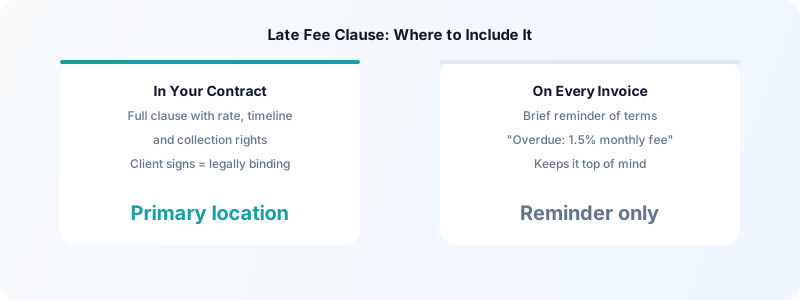
For your contract (full version):
Payment Terms and Late Fees
All invoices are due within [15/30] days of the invoice date. Invoices not paid within [15/30] days will be subject to a late fee of 1.5% per month (18% annually) on the outstanding balance, calculated from the original due date until the date payment is received. [Client Name] is responsible for all reasonable collection costs, including attorney fees, if collection action becomes necessary.
For your invoice (abbreviated reminder):
Payment due: [Date]. Overdue balances subject to 1.5% monthly late fee per our contract terms.
Keep the invoice reminder brief — it's a reminder of terms already agreed to in the contract, not the primary clause.
How to Add It to Existing Client Relationships
If you've been working with a client without a late fee clause and want to add one, introduce it when you next update your contract or service agreement:
"I've updated my standard contract to include late payment terms that apply to all new projects starting [date]. Please review the attached updated agreement."
Don't retroactively apply late fees to invoices issued before the clause was agreed to. Only apply it to work contracted after the client has acknowledged the updated terms.
For new clients, include the clause in your initial contract or statement of work. This makes it a normal part of onboarding, not an adversarial provision.
When and How to Actually Charge the Fee
Having a late fee clause doesn't mean you must charge it every time. Exercise professional judgment:
Charge it when:
- The client is persistently late (more than once per year)
- You've sent multiple reminders with no response
- The amount is significant enough to matter
- The client relationship is transactional rather than long-term
Consider waiving it when:
- A good long-term client has a genuine one-time delay
- The client proactively communicates a payment delay before you remind them
- Charging it would damage a relationship worth more than the fee
If you waive a fee, document it: "As a one-time courtesy, I'm waiving the late fee on this invoice. Future overdue invoices will be subject to the 1.5% monthly charge per our agreement."
This acknowledges the waiver explicitly while reinforcing that the clause still applies going forward.
How to Calculate the Late Fee
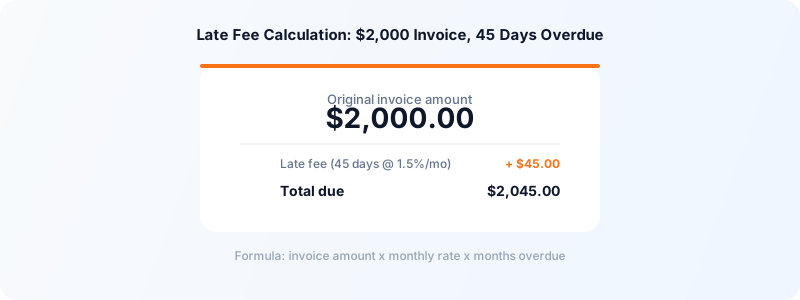
If a $2,000 invoice is 45 days overdue with a 1.5% monthly rate:
- Monthly rate: 1.5%
- 45 days = 1.5 months
- Late fee: $2,000 × 1.5% × 1.5 = $45
Send a revised invoice showing the original amount, the late fee calculation, and the new total due.
Connect Your Late Fee Clause to Your Time Records
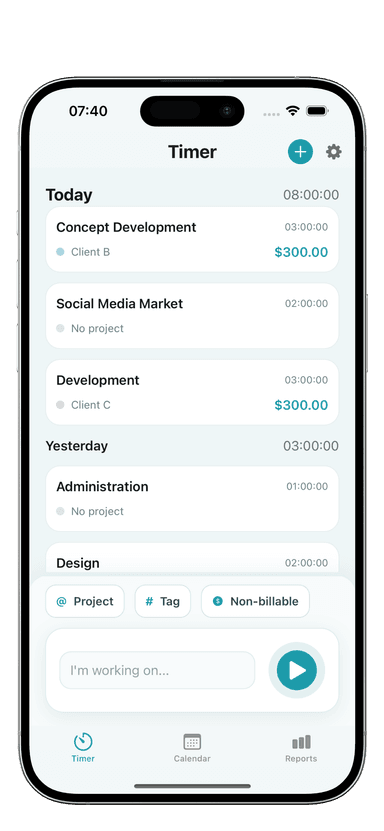
The strongest invoicing posture combines a clear late fee clause with detailed, trackable time logs. When you track every hour in Toggle Time Tracker and attach your time report to invoices, clients process payments faster — and the rare late payment is easier to resolve because the work is fully documented.
A time-backed invoice plus a professional late fee clause puts you in the strongest possible position for any payment dispute.
For how to handle a client who still doesn't pay despite these measures, see what to do when a freelance invoice is overdue.
The Professional Standard
A late fee clause isn't punitive — it's professional. It tells clients that you take your business seriously, that your time has value, and that payment terms are binding, not suggestions. Most clients who intend to pay on time don't object to late fee clauses at all — because they have no intention of triggering them.
Add it to your contract template today. It costs you nothing if clients pay on time, and it protects your income when they don't.
Download Toggle Time Tracker and track every billable hour — your time records are the foundation that makes every invoice clause enforceable.