The Home Office Tax Deduction for Freelancers: What Qualifies
If you work from home as a freelancer, the freelance home office deduction can meaningfully reduce your tax bill. But it only works if your space meets IRS requirements — and if you pick the right calculation method. Here's what you need to know to claim it correctly.
What Is the Home Office Deduction for Freelancers?
The home office deduction lets self-employed people deduct costs tied to a dedicated workspace in their home. You claim it on Schedule C, the same form where you report freelance income and other business expenses.
To qualify, your space must pass two IRS tests:
- Regular use: You use the space consistently for business, not just occasionally.
- Exclusive use: The space is used only for work. A desk in your living room where you also watch TV does not qualify.
Your home office also needs to be your principal place of business — meaning you handle administrative tasks, client calls, or actual work there, and you have no other fixed business location.
One important note: W-2 employees cannot claim this deduction. It applies only to self-employed workers reporting income on Schedule C. If you run a freelance business alongside a salaried job, you can still claim it for the freelance work.
For a broader look at what you can write off, see this complete guide to freelance tax deductions.
Two Methods: Simplified vs. Regular (Which to Choose)
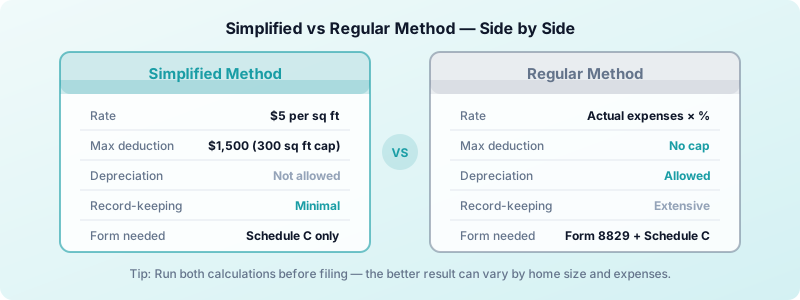
The IRS gives you two ways to calculate the home office deduction. You can choose the one that works best for your situation, and you can switch methods from year to year.
Simplified Method
You multiply your office square footage by $5, up to a maximum of 300 square feet. The most you can deduct is $1,500/year.
Example: Your home office is 200 sq ft. Deduction = 200 × $5 = $1,000.
The math is easy, no depreciation is involved, and you only need to fill in two fields on Schedule C. There is no carryover if your deduction exceeds your income — it simply disappears.
Regular Method
You calculate actual home expenses (rent or mortgage interest, utilities, insurance, repairs) and multiply by your business-use percentage.
Formula: office sq ft ÷ total home sq ft = business-use percentage.
Example: 200 sq ft office ÷ 1,600 sq ft home = 12.5%. If your total home expenses for the year are $24,000, your deduction is $24,000 × 12.5% = $3,000.
The regular method requires Form 8829 and more record-keeping, but it often produces a larger deduction — especially if you rent or pay a sizable mortgage.
Which should you pick?
Run both calculations before you file. If your office is small (under 150 sq ft) or your overall home expenses are low, the simplified method may come out ahead because it requires no documentation. If your home expenses are substantial, the regular method almost always wins.
What Counts as "Exclusive and Regular" Use?
The exclusive-use rule is where many freelancers accidentally disqualify themselves. The IRS is strict about this.
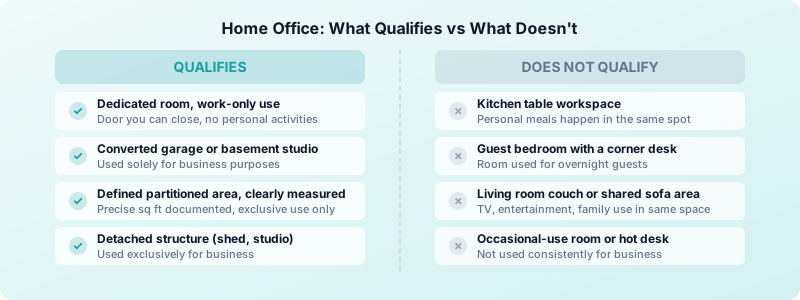
Passes the test:
- A dedicated room you use only for client work and administrative tasks
- A converted garage or basement you use solely as your studio or office
Fails the test:
- A kitchen table where you work during the day and eat meals in the evening
- A guest bedroom with a desk in the corner
- A shared living room workspace
A separate room with a door you can close is the clearest-cut case. If your office is a partitioned area of a larger room, you can still qualify — but you need to define the square footage precisely and keep the area genuinely separate from personal use.
The IRS may ask for documentation. Photos of your workspace, a floor plan with measurements, and consistent records all help substantiate your claim.
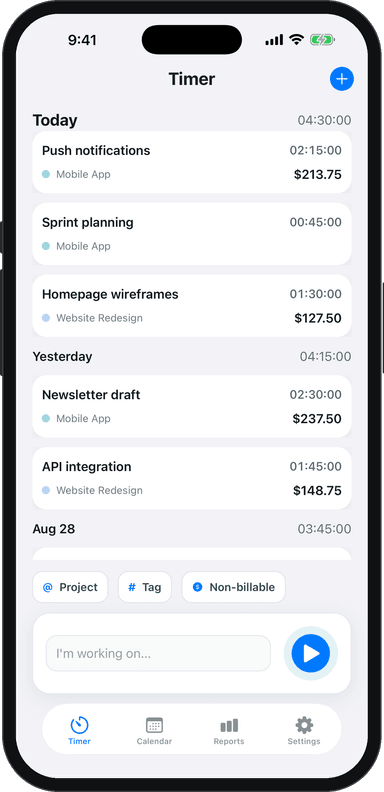
When you work from home, tracking your billable hours with an app like Toggle Time Tracker builds another layer of evidence — your logged work sessions show that your home office is actively used for business, not just occupied by a desk.
Other Home Expenses You Can Deduct
Beyond the home office deduction itself, you may be able to deduct specific expenses tied to your workspace.
Direct expenses (100% deductible): Costs that apply only to your home office, such as painting that room, repairing a window in it, or buying shelving specifically for your workspace.
Indirect expenses (deductible by percentage): Costs for the whole home that your office shares — utilities, homeowner's or renter's insurance, internet, and general repairs. You deduct the business-use percentage of each.
Mortgage interest and property taxes: If you own your home, these are included in the regular method calculation. They are partially deductible as a business expense via Form 8829.
Depreciation: The regular method lets you depreciate the business-use portion of your home over time. This increases your deduction now but may trigger a recapture tax when you sell the home, so factor that into your long-term planning.
One expense you cannot deduct under either method: your first phone line into the home. The IRS considers that a personal expense. A second dedicated business line is deductible.
Claiming the space is one thing; making it somewhere you can concentrate is another. See freelance home office setup.
How to Claim the Freelance Home Office Deduction
Here is exactly what to do:
- Measure your office. Get the precise square footage of your dedicated workspace and the total square footage of your home.
- Choose your method. Run the simplified and regular method calculations side by side to see which yields the larger deduction.
- Gather expense records. For the regular method, collect your rent or mortgage statements, utility bills, insurance premiums, and any repair receipts for the year.
- Fill out the right form. Simplified method: two entries directly on Schedule C. Regular method: complete Form 8829, then carry the result to Schedule C.
- File with Schedule C. The deduction flows through to your net self-employment income, reducing both income tax and self-employment tax.
A good way to make sure your numbers hold up: log your work hours consistently throughout the year. Toggle Time Tracker lets you track time by project from your iPhone with a single tap, building a clear record of when and how much you work from your home office. That data is useful if you ever need to demonstrate regular and exclusive business use.
If you also make estimated payments during the year, your home office deduction reduces your taxable income — meaning you may be able to lower those payments. See the freelance quarterly taxes guide for how to calculate what you owe.
The freelance home office deduction is one of the most valuable write-offs available to self-employed workers. Set up your workspace correctly, pick the right calculation method, and keep clean records. Done right, it can cut hundreds or thousands of dollars from your tax bill each year.
Download Toggle Time Tracker and start logging the hours that back up your home office deduction.