Freelance Early Payment Discount: How Much to Offer
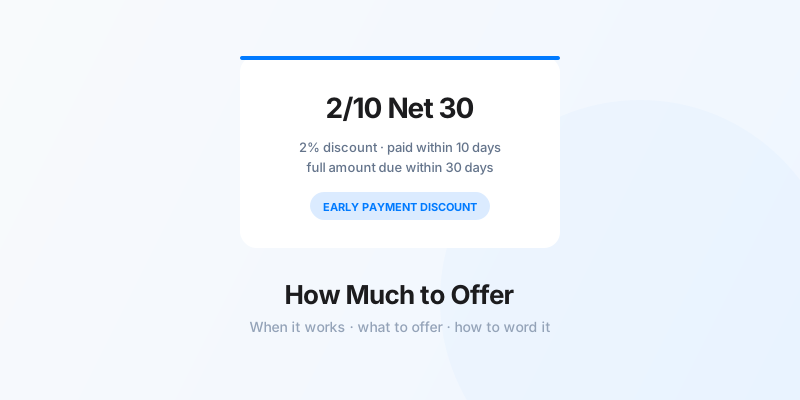
A freelance early payment discount is a small reduction you offer clients in exchange for paying faster than your standard terms. The most common version: "2% discount if paid within 5 days, otherwise Net 30." It's a simple tactic that can meaningfully speed up cash flow — but only if you structure it correctly and offer it to the right clients.
How Early Payment Discounts Work
The mechanics are straightforward. You invoice your standard amount with two options:
- Pay within 5 days: receive a 2% discount
- Pay within 30 days: pay the full amount
The notation on invoices is typically written as "2/10 Net 30" (pronounced "two-ten, net thirty") — meaning 2% discount if paid within 10 days, full amount due within 30.
You're essentially paying the client to give you your money sooner. For large invoices, even a 2% discount is financially significant to you in improved cash flow.
What Discount Percentage to Offer
The right discount percentage depends on what it's worth to you to get paid faster:
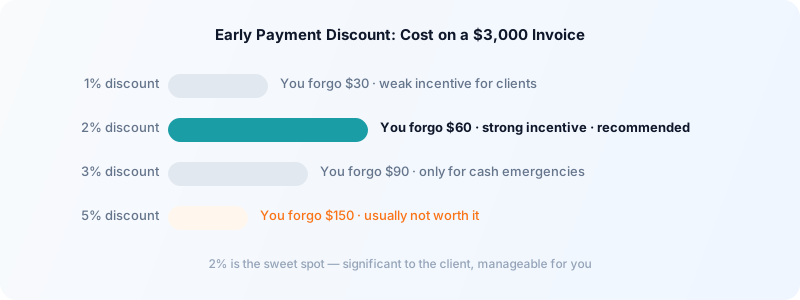
1%: Minimal incentive. Most clients who are going to pay quickly will do so without a discount. This rarely changes behavior.
2%: The industry standard. Enough to motivate action without giving away meaningful income. This is the rate to default to.
3-5%: Aggressive. Justifiable only if you have a serious cash flow problem or the invoice is unusually large. At 5%, you're effectively borrowing against future income at a high annualized rate.
A 2% discount for paying 25 days early annualizes to roughly 29% APR. That's the implicit "interest rate" you're paying for fast cash. It's worth it if you have urgent needs, but not as a permanent policy.
For most freelancers, 2/10 Net 30 is the right default when offering this term.
When to Offer It (and When Not To)
Early payment discounts work best in specific situations:
Good times to offer:
- Large invoices where a small % discount is worth it for improved cash flow
- Clients who are slow payers and you want to incentivize change
- Cash-strapped periods when you need money to cover your own expenses
- New clients you're building a relationship with
Avoid offering when:
- The client already pays quickly — you're giving away income unnecessarily
- Your standard terms are already short (Net 7 or Net 14)
- The invoice is small enough that the savings are trivial (2% of $300 = $6)
- You resent the discount — resentment erodes the client relationship over time
The best practice: offer it selectively, not universally. Include it in your invoicing terms for larger invoices or specific clients, and omit it from routine small invoices.
How to Word It on Your Invoice
Keep the language simple and clear:
Standard wording:
2% discount applied if payment is received by [specific date]. Full amount of $[amount] due by [standard due date].
Give a specific date rather than "within 10 days" — it's clearer and removes any ambiguity about when the clock starts.
Example:
Invoice total: $3,200 Pay $3,136 by April 11 (2% early payment discount) Full amount of $3,200 due by May 1
The specific numbers make it easy for the client to decide without having to do math.
Track Whether Clients Actually Take It
After offering early payment discounts, track the data. How many clients take you up on it? What's the average payment time for those who do vs. those who don't?
Toggle Time Tracker helps you understand your billable hours, but pair it with a simple invoice log that captures payment dates. After 3-6 months you'll have enough data to answer: is this discount actually moving the needle on my cash flow, or am I just giving away income?
If most clients who were going to pay fast are taking the discount (costing you money), but your slow-paying clients are still paying slow (not being moved by the offer), the discount isn't working. Either raise the percentage, change the terms, or drop the offer for those clients.
The Alternative: Deposits
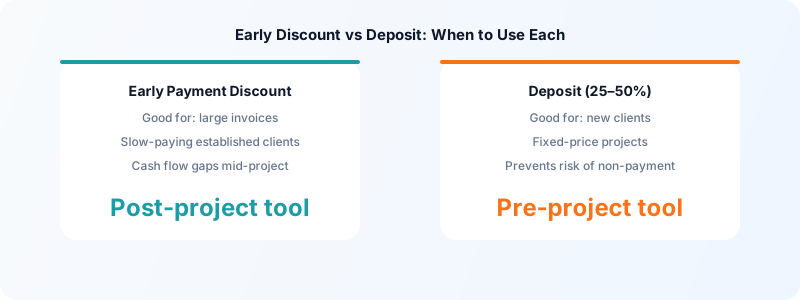
For many freelancers, a deposit structure is more effective than early payment discounts. Requiring 25-50% upfront eliminates the cash flow problem for the initial phase of work — you're not waiting for money you've already earned.
Deposits work especially well for fixed-price projects with clearly defined deliverables. For ongoing hourly work, a 50% deposit at project start followed by monthly or milestone-based invoices is a strong structure.
For everything related to getting paid reliably, see how to get freelance clients to pay on time for the full system.
The Bottom Line on Early Payment Discounts
A 2% early payment discount is a legitimate cash flow tool when used strategically. It's not something to offer on every invoice — but for large projects with slower-paying clients, it's an easy offer to add and often worth the small cost.
Price your work correctly, track every billable hour, and use payment tools strategically. That combination gets you paid reliably without constantly discounting your income.
Download Toggle Time Tracker and log every hour accurately — so you're always invoicing from a position of documented work, not memory.